Ch.2 - Atoms & Elements
Tro - Chemistry: A Molecular Approach 5th Edition
Tro5th EditionChemistry: A Molecular ApproachISBN: 9780134874371Non è quello che usi tu?Cambia libro di testo
Capitolo 2, Problema 62

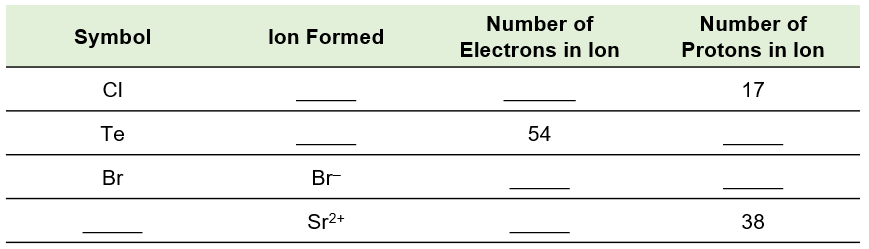
Fill in the blanks to complete the table.
Symbol Ion Formed Number of Electrons in Ion Number of Protons in Ion
Cl ______ ______ 17
Te ______ 54 ______
Br Br– ______ ______
______ Sr2+ ______ 38

Guida verificata passo dopo passo
1
Identify the atomic number of each element given in the table. The atomic number is equal to the number of protons in a neutral atom of the element. For Chlorine (Cl), it is 17; for Tellurium (Te), it is 52; for Bromine (Br), it is 35; and for Strontium (Sr), it is 38.
Determine the charge of each ion. For Cl, it typically forms a -1 charge (Cl-). For Te, given it has 54 electrons, it has gained 2 electrons compared to its neutral state, forming Te2-. For Br, it is indicated as Br- which also has a -1 charge. For Sr, it is indicated as Sr2+, meaning it has lost 2 electrons.
Calculate the number of electrons in each ion based on the charge. For Cl-, it gains 1 electron (total 18 electrons). For Te2-, it gains 2 electrons (total 54 electrons). For Br-, it gains 1 electron (total 36 electrons). For Sr2+, it loses 2 electrons (total 36 electrons).
Fill in the number of protons for each ion, which remains the same as the atomic number of the neutral atom. For Cl-, it is 17; for Te2-, it is 52; for Br-, it is 35; and for Sr2+, it is 38.
Complete the table by filling in the symbols of the ions and their respective electron and proton counts. For Cl, the ion is Cl- with 18 electrons and 17 protons. For Te, the ion is Te2- with 54 electrons and 52 protons. For Br, the ion is Br- with 36 electrons and 35 protons. For Sr, the ion is Sr2+ with 36 electrons and 38 protons.

Risposta video verificata per un problema simile:

Questa soluzione video è stata consigliata dai nostri tutor come utile per risolvere questo problema.
Durata del video:
3m

Concetti chiave

Ecco i concetti essenziali che devi comprendere per rispondere correttamente alla domanda.

Ionic Charge and Electron Configuration

Ionic charge refers to the net electrical charge of an ion, which is determined by the loss or gain of electrons relative to the neutral atom. For example, a cation like Sr²⁺ has lost two electrons, while an anion like Br⁻ has gained one. Understanding how to calculate the number of electrons in an ion based on its charge is essential for completing the table.
Video consigliato:
Percorso guidato
01:33
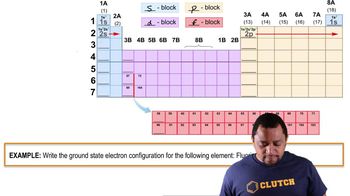
Electron Configuration Example

Atomic Number and Protons

The atomic number of an element is equal to the number of protons in its nucleus and defines the element itself. For instance, chlorine (Cl) has an atomic number of 17, meaning it has 17 protons. This number remains constant regardless of the ion's charge, which is crucial for determining the number of protons in the ions listed in the table.
Video consigliato:
Percorso guidato
02:14
Neutron-Proton Ratio

Relationship Between Electrons and Protons in Ions

In ions, the relationship between electrons and protons determines the overall charge. A neutral atom has equal numbers of protons and electrons, but in ions, this balance is disrupted. For example, in a Br⁻ ion, there are more electrons than protons, while in Sr²⁺, there are fewer electrons. This concept is vital for accurately filling in the blanks regarding the number of electrons in each ion.
Video consigliato:
Percorso guidato
02:43
Relationship between ∆E°, ∆G°, and K