Ch.2 - Atoms & Elements
Tro - Chemistry: A Molecular Approach 5th Edition
Tro5th EditionChemistry: A Molecular ApproachISBN: 9780134874371Non è quello che usi tu?Cambia libro di testo
Capitolo 2, Problema 120

Naturally occurring chlorine is composed of two isotopes: 75.76% Cl-35 (mass 34.9688 amu) and 24.24% Cl-37 (mass 36.9659 amu). Naturally occurring oxygen is composed of three isotopes: 99.757% O-16 (mass 15.9949 amu), 0.038% O-17 (mass 16.9991 amu), and 0.205% O-18 (mass 17.9991 amu). The compound dichlorine monoxide is composed of two chlorine atoms and one oxygen atom bonded together to form the Cl2O molecule. How many Cl2O molecules of different masses naturally exist? Give the masses of the three most abundant Cl2O molecules.

Guida verificata passo dopo passo
1
Identify the isotopes of chlorine and oxygen that will contribute to the formation of Cl2O. For chlorine, these are Cl-35 and Cl-37; for oxygen, these are O-16, O-17, and O-18.
Calculate the possible masses of Cl2O by combining the masses of the isotopes. Since Cl2O consists of two chlorine atoms and one oxygen atom, consider all combinations: (2 x Cl-35 + O-16), (2 x Cl-35 + O-17), (2 x Cl-35 + O-18), (Cl-35 + Cl-37 + O-16), (Cl-35 + Cl-37 + O-17), (Cl-35 + Cl-37 + O-18), (2 x Cl-37 + O-16), (2 x Cl-37 + O-17), (2 x Cl-37 + O-18).
Determine the relative abundance of each Cl2O molecule by multiplying the natural abundances of the contributing isotopes. For example, the abundance of Cl2O with 2 x Cl-35 and O-16 is the product of the abundance of Cl-35 squared and the abundance of O-16.
Rank the Cl2O molecules based on their calculated relative abundances to identify the three most abundant molecules.
List the masses of the three most abundant Cl2O molecules based on the calculations from step 2.

Risposta video verificata per un problema simile:

Questa soluzione video è stata consigliata dai nostri tutor come utile per risolvere questo problema.
Durata del video:
7m

Concetti chiave

Ecco i concetti essenziali che devi comprendere per rispondere correttamente alla domanda.

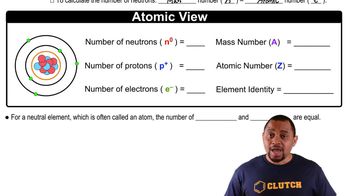
Isotopes

Isotopes are variants of a chemical element that have the same number of protons but different numbers of neutrons, resulting in different atomic masses. For example, chlorine has two stable isotopes, Cl-35 and Cl-37, which contribute to the average atomic mass of chlorine in nature. Understanding isotopes is crucial for calculating the mass of compounds formed from elements with multiple isotopes.
Video consigliato:

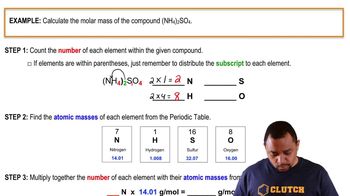
Molecular Mass Calculation

Molecular mass is the sum of the atomic masses of all atoms in a molecule. In the case of dichlorine monoxide (Cl2O), the molecular mass is calculated by adding the masses of two chlorine atoms and one oxygen atom. This concept is essential for determining the different possible masses of Cl2O molecules based on the isotopes of chlorine and oxygen present.
Video consigliato:
Percorso guidato
03:12
Molar Mass Calculation Example

Natural Abundance

Natural abundance refers to the relative proportions of different isotopes of an element found in nature. For instance, the natural abundance of Cl-35 and Cl-37 affects the average mass of chlorine used in molecular mass calculations. This concept is important for predicting the most common isotopic combinations in compounds like Cl2O and determining the masses of the most abundant molecules.
Video consigliato:
Percorso guidato
01:26
Nature of Energy