Ch.2 - Atoms & Elements
Tro - Chemistry: A Molecular Approach 5th Edition
Tro5th EditionChemistry: A Molecular ApproachISBN: 9780134874371Non è quello che usi tu?Cambia libro di testo
Capitolo 2, Problema 106

Neutron stars are composed of solid nuclear matter, primarily neutrons. Assume the radius of a neutron is approximately 1.0×10⁻¹³ cm. Calculate the density of a neutron. [Hint: For a sphere V = (4/3)πr3.] Assuming that a neutron star has the same density as a neutron, calculate the mass (in kg) of a small piece of a neutron star the size of a spherical pebble with a radius of 0.10 mm.

Guida verificata passo dopo passo
1
Calculate the volume of a neutron using the formula for the volume of a sphere: \(V = \frac{4}{3}\pi r^3\), where \(r\) is the radius of the neutron.
Substitute the given radius of the neutron, \(1.0 \times 10^{-13}\) cm, into the volume formula to find the volume of a neutron.
Use the mass of a neutron, approximately \(1.675 \times 10^{-24}\) g, to calculate the density of a neutron using the formula: \(\text{Density} = \frac{\text{Mass}}{\text{Volume}}\).
Convert the radius of the pebble from millimeters to centimeters (0.10 mm = 0.010 cm) and calculate the volume of the pebble using the sphere volume formula: \(V = \frac{4}{3}\pi r^3\).
Multiply the volume of the pebble by the density of a neutron to find the mass of the pebble in grams, and then convert the mass to kilograms.

Risposta video verificata per un problema simile:

Questa soluzione video è stata consigliata dai nostri tutor come utile per risolvere questo problema.
Durata del video:
3m

Concetti chiave

Ecco i concetti essenziali che devi comprendere per rispondere correttamente alla domanda.

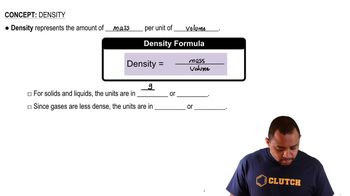
Density

Density is defined as mass per unit volume, typically expressed in grams per cubic centimeter (g/cm³) or kilograms per cubic meter (kg/m³). It is a crucial property that helps determine how much matter is packed into a given space. In this context, understanding density allows us to calculate the mass of a neutron based on its volume and the relationship between mass and density.
Video consigliato:
Percorso guidato
01:56
Density Concepts

Volume of a Sphere

The volume of a sphere is calculated using the formula V = (4/3)πr³, where r is the radius of the sphere. This formula is essential for determining the volume of both a neutron and a small piece of a neutron star, as it allows us to quantify the space occupied by these spherical objects. Accurate volume calculations are necessary to find the corresponding mass when density is known.
Video consigliato:
Percorso guidato
02:35
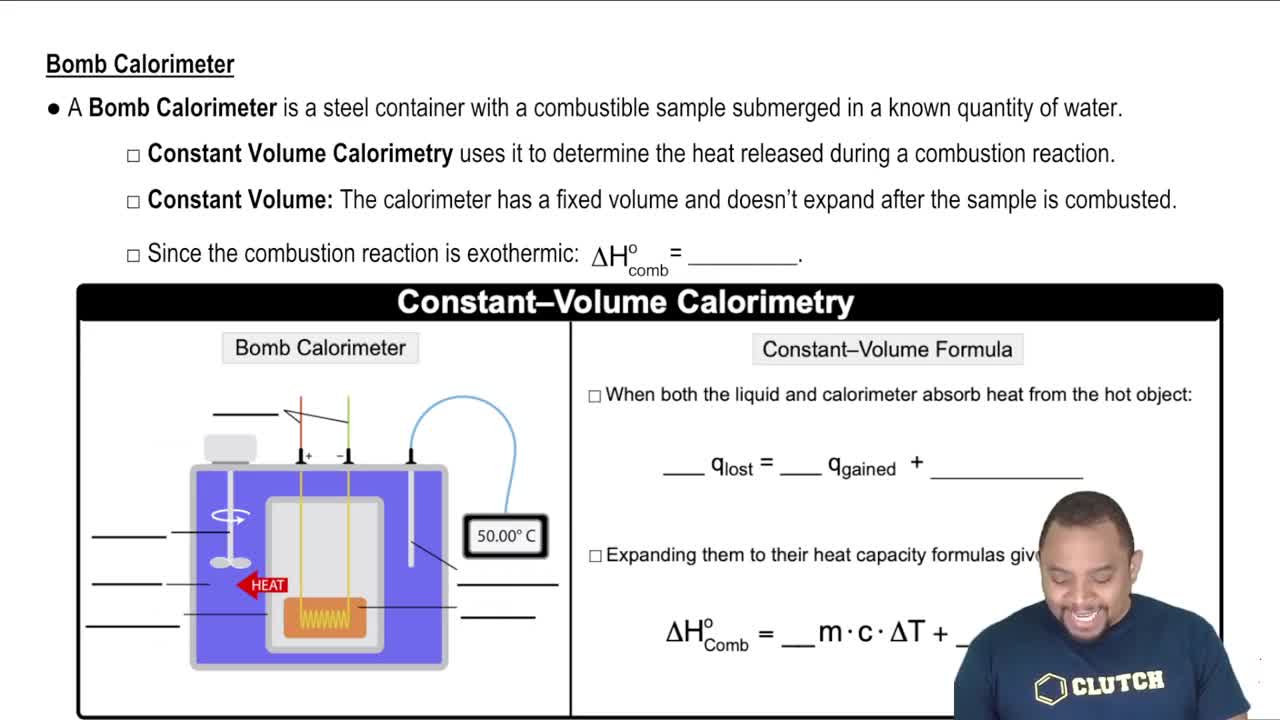
Constant-Volume Calorimetry

Mass Calculation

Mass can be calculated using the formula mass = density × volume. This relationship is fundamental in physics and chemistry, as it connects the amount of matter (mass) to how densely it is packed (density) and the space it occupies (volume). In the context of the question, this formula will be used to find the mass of a neutron star fragment by applying the density of a neutron to the calculated volume of the pebble-sized sphere.
Video consigliato:
Percorso guidato
03:12
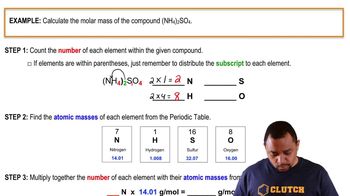
Molar Mass Calculation Example