Ch.20 - Electrochemistry
Tro - Chemistry: A Molecular Approach 5th Edition
Tro5th EditionChemistry: A Molecular ApproachISBN: 9780134874371Non è quello che usi tu?Cambia libro di testo
Capitolo 20, Problema 101

A major source of sodium metal is the electrolysis of molten sodium chloride. What magnitude of current produces 1.0 kg of sodium metal in 1 hour?

Guida verificata passo dopo passo
1
Identify the chemical reaction involved in the electrolysis of molten sodium chloride: \( 2\text{NaCl} \rightarrow 2\text{Na} + \text{Cl}_2 \).
Determine the number of moles of sodium produced: Use the molar mass of sodium (approximately 22.99 g/mol) to convert 1.0 kg of sodium to moles.
Calculate the total charge required: Since 2 moles of electrons are needed to produce 2 moles of sodium, use Faraday's constant (approximately 96485 C/mol) to find the total charge.
Relate charge to current: Use the formula \( Q = I \times t \), where \( Q \) is the total charge, \( I \) is the current, and \( t \) is the time in seconds (convert 1 hour to seconds).
Solve for the current \( I \): Rearrange the formula to \( I = \frac{Q}{t} \) and substitute the known values to find the magnitude of the current.

Risposta video verificata per un problema simile:

Questa soluzione video è stata consigliata dai nostri tutor come utile per risolvere questo problema.
Durata del video:
2m

Concetti chiave

Ecco i concetti essenziali che devi comprendere per rispondere correttamente alla domanda.

Electrolysis

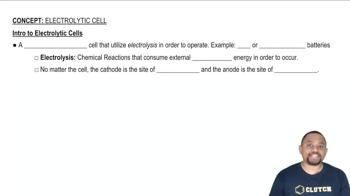
Electrolysis is a chemical process that uses electrical energy to drive a non-spontaneous reaction. In the case of sodium chloride, the process involves breaking down the compound into its constituent elements, sodium and chlorine, by passing an electric current through molten sodium chloride. This process is essential for producing sodium metal from its ionic form.
Video consigliato:
Percorso guidato
01:21
The Electrolytic Cell

Faraday's Laws of Electrolysis

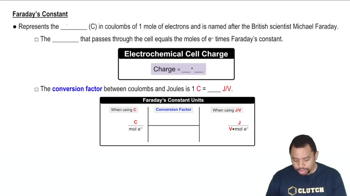
Faraday's Laws of Electrolysis quantify the relationship between the amount of substance produced at an electrode and the quantity of electric charge passed through the electrolyte. The first law states that the mass of a substance altered at an electrode is directly proportional to the total electric charge passed. This principle is crucial for calculating the current needed to produce a specific mass of sodium metal.
Video consigliato:
Percorso guidato
01:40
Faraday's Constant in Electrochemistry

Current and Charge Relationship

The relationship between current (I), charge (Q), and time (t) is given by the equation Q = I × t. This means that the total charge is the product of the current and the time for which it flows. Understanding this relationship is vital for determining the magnitude of current required to produce a certain mass of sodium metal in a specified time frame.
Video consigliato: