Ch.20 - Electrochemistry
Tro - Chemistry: A Molecular Approach 5th Edition
Tro5th EditionChemistry: A Molecular ApproachISBN: 9780134874371Non è quello che usi tu?Cambia libro di testo
Capitolo 20, Problema 109b

Determine whether HI can dissolve each metal sample. If it can, write a balanced chemical reaction showing how the metal dissolves in HI and determine the minimum volume of 3.5 M HI required to completely dissolve the sample. b. 4.85 g Cu

Guida verificata passo dopo passo
1
Identify the reactivity of the metal with HI. Copper (Cu) is less reactive and does not react with HI under normal conditions, so it will not dissolve in HI.
Since copper does not react with HI, there is no balanced chemical equation to write for the dissolution of copper in HI.
If copper were to react, the general form of the reaction with an acid like HI would be: \[ \text{Cu} + 2\text{HI} \rightarrow \text{CuI}_2 + \text{H}_2 \]. However, this reaction does not occur with HI.
Since there is no reaction, there is no need to calculate the volume of HI required to dissolve copper.
In summary, copper does not dissolve in HI, and no further calculations are necessary.

Risposta video verificata per un problema simile:

Questa soluzione video è stata consigliata dai nostri tutor come utile per risolvere questo problema.
Durata del video:
4m

Concetti chiave

Ecco i concetti essenziali che devi comprendere per rispondere correttamente alla domanda.

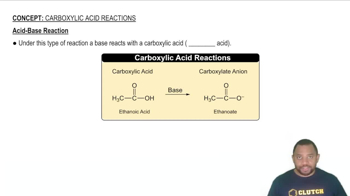
Acid-Base Reactions

Acid-base reactions involve the transfer of protons (H+) between reactants. Hydroiodic acid (HI) is a strong acid that can donate protons, which can react with certain metals to form metal iodides and hydrogen gas. Understanding this concept is crucial for predicting whether a metal will dissolve in HI and for writing the balanced chemical equations for the reactions.
Video consigliato:
Percorso guidato
01:09
Acid-Base Reaction

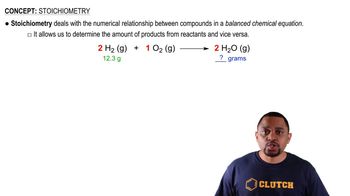
Stoichiometry

Stoichiometry is the calculation of reactants and products in chemical reactions based on the balanced equation. It allows us to determine the relationships between the amounts of substances involved. In this case, stoichiometry will help calculate the minimum volume of 3.5 M HI needed to dissolve a given mass of copper (Cu) by using the molar ratios from the balanced reaction.
Video consigliato:
Percorso guidato
01:16
Stoichiometry Concept

Molarity and Volume Calculations

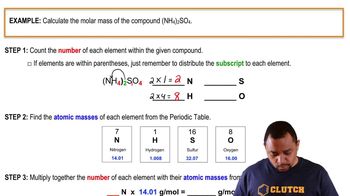
Molarity (M) is a measure of concentration defined as moles of solute per liter of solution. To find the volume of HI required to dissolve the copper sample, one must convert the mass of copper to moles and then use the molarity of the HI solution to find the necessary volume. This concept is essential for practical applications in laboratory settings.
Video consigliato:
Percorso guidato
03:12
Molar Mass Calculation Example