Ch.21 - Radioactivity & Nuclear Chemistry
Tro - Chemistry: A Molecular Approach 5th Edition
Tro5th EditionChemistry: A Molecular ApproachISBN: 9780134874371Non è quello che usi tu?Cambia libro di testo
Capitolo 21, Problema 36d

Fill in the missing particles in each nuclear equation. d. 7535Br → ____ + 0+1e

Guida verificata passo dopo passo
1
Identify the type of decay occurring in the given nuclear equation. The presence of 0+1e, which represents a positron, indicates that the decay process is positron emission.
Understand that in positron emission, a proton in the nucleus is converted into a neutron, and a positron is emitted. This process decreases the atomic number by one but keeps the mass number the same.
Write the general form of the nuclear equation for positron emission: AZX → AZ-1Y + 0+1e, where A is the mass number, Z is the atomic number, X is the parent nucleus, and Y is the daughter nucleus.
Apply the general form to the specific case: 7535Br → 7534Y + 0+1e. Here, the atomic number decreases by one, so the element symbol changes from Br (bromine) to Se (selenium), which has an atomic number of 34.
Complete the nuclear equation by filling in the missing particle: 7535Br → 7534Se + 0+1e.

Risposta video verificata per un problema simile:

Questa soluzione video è stata consigliata dai nostri tutor come utile per risolvere questo problema.
Durata del video:
2m

Concetti chiave

Ecco i concetti essenziali che devi comprendere per rispondere correttamente alla domanda.

Nuclear Reactions

Nuclear reactions involve changes in an atom's nucleus, resulting in the transformation of one element into another. These reactions can include processes such as alpha decay, beta decay, and gamma emission. Understanding the type of nuclear reaction is crucial for predicting the products formed, as different reactions follow specific rules regarding particle conservation and transformation.
Video consigliato:
Percorso guidato
02:06
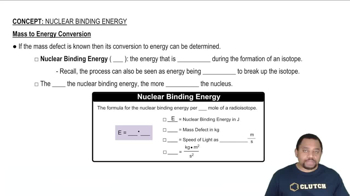
Nuclear Binding Energy

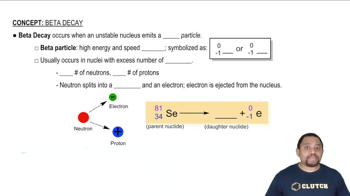
Beta Decay

Beta decay is a type of radioactive decay in which a neutron in the nucleus is transformed into a proton, emitting a beta particle (an electron or positron) in the process. This transformation increases the atomic number of the element by one while keeping the mass number unchanged. Recognizing beta decay is essential for completing nuclear equations, as it directly influences the identity of the resulting nuclide.
Video consigliato:

Conservation of Nucleons

In nuclear reactions, the conservation of nucleons (protons and neutrons) must be maintained. This principle states that the total number of nucleons before and after the reaction must remain constant. When filling in missing particles in a nuclear equation, it is important to ensure that the sum of the atomic numbers and mass numbers on both sides of the equation is equal, reflecting this conservation law.
Video consigliato:
Percorso guidato
01:48
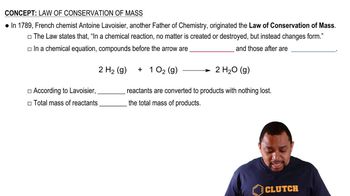
Law of Conservation of Mass