
Ch.21 - Radioactivity & Nuclear Chemistry
Tro - Chemistry: A Molecular Approach 5th Edition
Tro5th EditionChemistry: A Molecular ApproachISBN: 9780134874371Non è quello che usi tu?Cambia libro di testo
Capitolo 21, Problema 74

If a 55-gram laboratory mouse is exposed to a dose of 20.5 rad of radiation, how much energy is absorbed by the mouse’s body?

Guida verificata passo dopo passo
1
Understand that 1 rad is equivalent to 0.01 joules of energy absorbed per kilogram of tissue.
Calculate the mass of the mouse in kilograms by converting grams to kilograms. (55 grams = 0.055 kilograms)
Use the formula: Energy absorbed (in joules) = dose (in rads) × mass (in kg) × 0.01 J/kg per rad.
Substitute the given values into the formula: Energy absorbed = 20.5 rads × 0.055 kg × 0.01 J/kg per rad.
Perform the multiplication to find the energy absorbed in joules.

Concetti chiave

Ecco i concetti essenziali che devi comprendere per rispondere correttamente alla domanda.

Radiation Dose

Radiation dose, measured in units such as rad, quantifies the amount of energy absorbed by a material, typically biological tissue, from ionizing radiation. One rad is defined as the absorption of 100 ergs of energy per gram of tissue. Understanding this concept is crucial for calculating the energy absorbed by the mouse based on its mass and the radiation dose it receives.
Video consigliato:
Percorso guidato
02:52
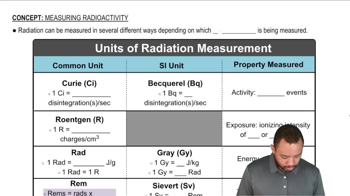
Units of Radiation Measurement

Energy Absorption Calculation

To determine the energy absorbed by an object from radiation, the formula used is: Energy (in ergs) = Dose (in rads) × Mass (in grams). This relationship allows for the straightforward calculation of energy absorbed by multiplying the radiation dose by the mass of the object, which in this case is the laboratory mouse.
Video consigliato:
Percorso guidato
01:51
Gibbs Free Energy of Reactions

Unit Conversion

In scientific calculations, it is often necessary to convert units to ensure consistency and accuracy. For example, while energy may be expressed in ergs, it can also be converted to joules (1 erg = 10^-7 joules). Understanding unit conversion is essential for interpreting results and ensuring that calculations align with standard scientific practices.
Video consigliato:
Percorso guidato
01:56
Conversion Factors