Ch.3 - Molecules and Compounds
Tro - Chemistry: A Molecular Approach 5th Edition
Tro5th EditionChemistry: A Molecular ApproachISBN: 9780134874371Non è quello che usi tu?Cambia libro di testo
Capitolo 3, Problema 93

What is the empirical formula of nitrogen chloride given that a 0.77 mg sample of nitrogen reacts with chlorine to form 6.61 mg of the chloride?

Guida verificata passo dopo passo
1
Determine the mass of chlorine in the compound by subtracting the mass of nitrogen from the total mass of the nitrogen chloride: \(6.61 \text{ mg} - 0.77 \text{ mg}\).
Convert the mass of nitrogen (0.77 mg) to moles using the molar mass of nitrogen (14.01 g/mol).
Convert the mass of chlorine (calculated in step 1) to moles using the molar mass of chlorine (35.45 g/mol).
Calculate the mole ratio of nitrogen to chlorine by dividing the moles of each element by the smallest number of moles calculated in steps 2 and 3.
Use the mole ratio to determine the empirical formula by expressing the ratio as the smallest whole numbers.

Concetti chiave

Ecco i concetti essenziali che devi comprendere per rispondere correttamente alla domanda.

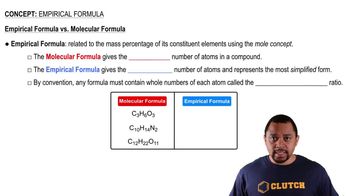
Empirical Formula

The empirical formula represents the simplest whole-number ratio of the elements in a compound. It is derived from the mass of each element present in a sample and is crucial for understanding the composition of the compound. For example, if a compound contains nitrogen and chlorine in a 1:1 ratio, its empirical formula would be represented as NCl.
Video consigliato:
Percorso guidato
02:26
Empirical vs Molecular Formula

Mass Conservation

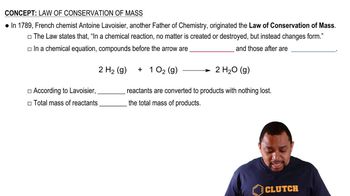
The law of conservation of mass states that mass is neither created nor destroyed in a chemical reaction. This principle allows us to calculate the mass of reactants and products, ensuring that the total mass before the reaction equals the total mass after. In this question, the mass of nitrogen and chlorine must equal the mass of nitrogen chloride formed.
Video consigliato:
Percorso guidato
01:48
Law of Conservation of Mass

Stoichiometry

Stoichiometry involves the calculation of reactants and products in chemical reactions based on balanced chemical equations. It allows chemists to predict the amounts of substances consumed and produced. In this case, stoichiometry will help determine the ratio of nitrogen to chlorine in the empirical formula of nitrogen chloride based on the masses provided.
Video consigliato:
Percorso guidato
01:16
Stoichiometry Concept