Ch.3 - Molecules and Compounds
Tro - Chemistry: A Molecular Approach 5th Edition
Tro5th EditionChemistry: A Molecular ApproachISBN: 9780134874371Non è quello che usi tu?Cambia libro di testo
Capitolo 3, Problema 113

A Freon leak in the air-conditioning system of an old car releases 25 g of CF2Cl2 per month. What mass of chlorine does this car emit into the atmosphere each year?

Guida verificata passo dopo passo
1
Determine the molar mass of CF2Cl2. Carbon (C) has an atomic mass of about 12 g/mol, fluorine (F) has an atomic mass of about 19 g/mol, and chlorine (Cl) has an atomic mass of about 35.5 g/mol. The molar mass of CF2Cl2 is calculated as: Molar mass = 12 + (2 \(\times\) 19) + (2 \(\times\) 35.5).
Calculate the moles of CF2Cl2 released per month by using the formula: Moles of CF2Cl2 = mass of CF2Cl2 / molar mass of CF2Cl2.
Determine the mass of chlorine in each mole of CF2Cl2. Since there are two chlorine atoms in each molecule of CF2Cl2, the mass of chlorine per mole of CF2Cl2 is 2 \(\times\) 35.5 g/mol.
Calculate the total mass of chlorine released per month by multiplying the moles of CF2Cl2 by the mass of chlorine per mole of CF2Cl2.
To find the annual emission of chlorine, multiply the monthly chlorine emission by 12 (the number of months in a year).

Risposta video verificata per un problema simile:

Questa soluzione video è stata consigliata dai nostri tutor come utile per risolvere questo problema.
Durata del video:
5m

Concetti chiave

Ecco i concetti essenziali che devi comprendere per rispondere correttamente alla domanda.

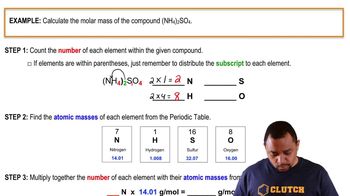
Molar Mass Calculation

To determine the mass of chlorine emitted, one must first calculate the molar mass of CF2Cl2 (dichlorodifluoromethane). The molar mass is the sum of the atomic masses of all atoms in the molecule: carbon (C), fluorine (F), and chlorine (Cl). This calculation is essential for converting grams of CF2Cl2 to moles, which will then allow for the determination of the mass of chlorine released.
Video consigliato:
Percorso guidato
03:12
Molar Mass Calculation Example

Stoichiometry

Stoichiometry is the branch of chemistry that deals with the relationships between the quantities of reactants and products in a chemical reaction. In this case, understanding the stoichiometric ratios of CF2Cl2 and chlorine (Cl) is crucial to calculate how much chlorine is released from the given mass of CF2Cl2. This involves using the mole ratio derived from the chemical formula to find the corresponding mass of chlorine.
Video consigliato:
Percorso guidato
01:16
Stoichiometry Concept

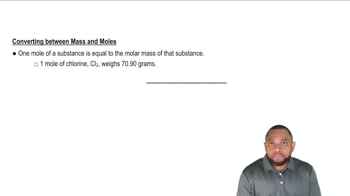
Mass to Moles Conversion

Converting mass to moles is a fundamental concept in chemistry that allows for the quantification of substances in reactions. This conversion uses the formula: moles = mass (g) / molar mass (g/mol). In this scenario, it is necessary to convert the mass of CF2Cl2 released monthly into moles to subsequently find the mass of chlorine emitted over a year, thereby linking the mass of the compound to the amount of chlorine produced.
Video consigliato:
Percorso guidato
02:28
Mass and Moles Conversion