Ch.3 - Molecules and Compounds
Tro - Chemistry: A Molecular Approach 5th Edition
Tro5th EditionChemistry: A Molecular ApproachISBN: 9780134874371Non è quello che usi tu?Cambia libro di testo
Capitolo 3, Problema 102

Classify each compound as organic or inorganic: a. C8H18 b. CH3NH2 c. CaO d. FeCO3

Guida verificata passo dopo passo
1
Identify the general characteristics of organic compounds, which typically contain carbon and hydrogen, often with C-H bonds.
Recognize that inorganic compounds generally do not have C-H bonds and may include metals, salts, and minerals.
Examine compound a, C8H18: It contains only carbon and hydrogen, indicating it is an organic compound.
Examine compound b, CH3NH2: It contains carbon and hydrogen, along with nitrogen, indicating it is an organic compound.
Examine compounds c, CaO, and d, FeCO3: Both contain metals (calcium and iron, respectively) and do not have C-H bonds, indicating they are inorganic compounds.

Concetti chiave

Ecco i concetti essenziali che devi comprendere per rispondere correttamente alla domanda.

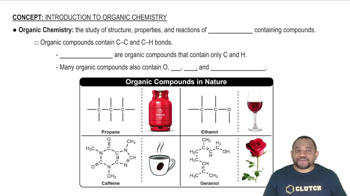
Organic Compounds

Organic compounds are primarily composed of carbon atoms, often in combination with hydrogen, oxygen, nitrogen, and other elements. They typically contain carbon-hydrogen (C-H) bonds and are associated with living organisms. Common examples include hydrocarbons, alcohols, and amino acids.
Video consigliato:
Percorso guidato
02:26
Introduction to Organic Chemistry

Inorganic Compounds

Inorganic compounds generally do not contain carbon-hydrogen bonds and include a wide range of substances such as minerals, metals, and salts. They can be composed of metals, nonmetals, and metalloids, and often play crucial roles in various chemical processes and reactions.
Video consigliato:
Percorso guidato
02:11
Ionic Compounds Naming

Classification Criteria

The classification of compounds as organic or inorganic is based on their molecular structure and composition. Organic compounds typically contain carbon and are associated with biological processes, while inorganic compounds encompass a broader range of substances that do not fit this definition. Understanding these criteria is essential for accurate classification.
Video consigliato:
Percorso guidato
04:22
Ligand Classification