Ch.3 - Molecules and Compounds
Tro - Chemistry: A Molecular Approach 5th Edition
Tro5th EditionChemistry: A Molecular ApproachISBN: 9780134874371Non è quello che usi tu?Cambia libro di testo
Capitolo 3, Problema 24a

Determine the number of each type of atom in each formula. a. Ca(NO2)2 d. Mg(HCO3)2

Guida verificata passo dopo passo
1
Identify the elements present in the compound: Calcium (Ca), Nitrogen (N), and Oxygen (O).
Recognize that the subscript outside the parentheses applies to all elements inside the parentheses. Here, (NO2)2 means there are 2 NO2 groups.
Calculate the number of Calcium (Ca) atoms: There is no subscript next to Ca, so there is 1 Ca atom.
Calculate the number of Nitrogen (N) atoms: Each NO2 group contains 1 N atom, and there are 2 NO2 groups, so there are 2 N atoms.
Calculate the number of Oxygen (O) atoms: Each NO2 group contains 2 O atoms, and there are 2 NO2 groups, so there are 4 O atoms.

Risposta video verificata per un problema simile:

Questa soluzione video è stata consigliata dai nostri tutor come utile per risolvere questo problema.
Durata del video:
1m

Concetti chiave

Ecco i concetti essenziali che devi comprendere per rispondere correttamente alla domanda.

Chemical Formula Interpretation

A chemical formula represents the types and numbers of atoms in a compound. In the formula Ca(NO2)2, 'Ca' stands for calcium, while 'NO2' indicates a nitrite group. The subscript '2' outside the parentheses means that there are two nitrite groups in the compound, which affects the total count of nitrogen and oxygen atoms.
Video consigliato:
Percorso guidato
03:13
Intepreting the Band of Stability

Counting Atoms in Compounds

To determine the number of each type of atom in a compound, one must account for both the elements present and their respective subscripts. For example, in Ca(NO2)2, there is one calcium atom, two nitrogen atoms (from 2 x NO2), and four oxygen atoms (from 2 x 2 in NO2). This systematic counting is essential for understanding the composition of the compound.
Video consigliato:

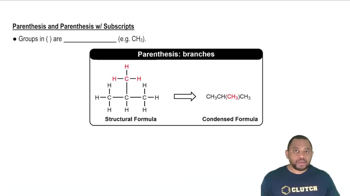
Parentheses in Chemical Formulas

Parentheses in chemical formulas indicate that the enclosed group of atoms is a distinct unit that can be multiplied by a subscript. In Ca(NO2)2, the parentheses around NO2 signify that the entire nitrite group is repeated twice, which is crucial for accurately calculating the total number of each atom in the compound.
Video consigliato:
Percorso guidato
01:35
Parenthesis and Parenthesis w/ Subscripts