Ch.3 - Molecules and Compounds
Tro - Chemistry: A Molecular Approach 5th Edition
Tro5th EditionChemistry: A Molecular ApproachISBN: 9780134874371Non è quello che usi tu?Cambia libro di testo
Capitolo 3, Problema 136

Element A is an atomic element, and element B is a diatomic molecular element. Using circles to represent atoms of A and squares to represent atoms of B, draw molecular-level views of each element.

Guida verificata passo dopo passo
1
Identify the characteristics of each element: Element A is an atomic element, meaning it exists as individual atoms. Element B is a diatomic molecular element, meaning it exists as molecules composed of two atoms.
Use circles to represent atoms of Element A. Since Element A is atomic, each circle will represent a single atom of A.
Use squares to represent atoms of Element B. Since Element B is diatomic, each molecule of B will be represented by two squares connected together.
Draw several individual circles to represent the atomic nature of Element A. These circles should be separate from each other, indicating that they do not form molecules.
Draw several pairs of connected squares to represent the diatomic nature of Element B. Each pair of squares should be connected to show that they form a diatomic molecule.

Risposta video verificata per un problema simile:

Questa soluzione video è stata consigliata dai nostri tutor come utile per risolvere questo problema.
Durata del video:
4m

Concetti chiave

Ecco i concetti essenziali che devi comprendere per rispondere correttamente alla domanda.

Atomic Elements

Atomic elements consist of single atoms that are not bonded to other atoms. These elements exist independently and are represented by their atomic symbols on the periodic table. For example, helium (He) is an atomic element, where each atom is a standalone entity. Understanding atomic elements is crucial for visualizing their molecular-level representation.
Video consigliato:
Percorso guidato
02:35
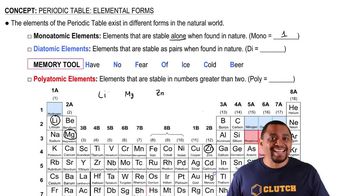
Elemental Forms of Elements

Diatomic Molecular Elements

Diatomic molecular elements are composed of two atoms bonded together, typically of the same element. Common examples include hydrogen (H2) and oxygen (O2). These molecules are represented as pairs of atoms, which can be depicted using different shapes, such as squares for clarity. Recognizing the structure of diatomic molecules is essential for accurately illustrating their molecular-level views.
Video consigliato:
Percorso guidato
03:10
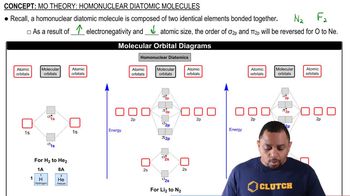
Homonuclear Diatomic Molecules

Molecular-Level Representation

Molecular-level representation involves visualizing the arrangement and bonding of atoms in a substance. This can be done using various symbols or shapes to denote different types of atoms and their connections. For instance, circles can represent atomic elements, while squares can represent diatomic molecules. This representation helps in understanding the composition and structure of different elements at a microscopic level.
Video consigliato:
Percorso guidato
02:38
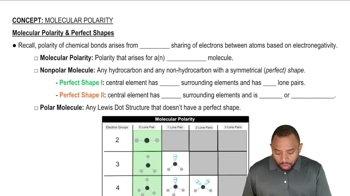
Molecular Polarity