Ch.3 - Molecules and Compounds
Tro - Chemistry: A Molecular Approach 5th Edition
Tro5th EditionChemistry: A Molecular ApproachISBN: 9780134874371Non è quello che usi tu?Cambia libro di testo
Capitolo 3, Problema 65a

How many molecules are in each sample? a. 6.5 g H2O c. 22.1 g O2 d. 19.3 g C8H10

Guida verificata passo dopo passo
1
Determine the molar mass of water (H2O) by adding the atomic masses of hydrogen and oxygen: \(2 \times 1.01\, \text{g/mol} + 16.00\, \text{g/mol}\).
Calculate the number of moles of water in the sample using the formula: \(\text{moles} = \frac{\text{mass}}{\text{molar mass}}\).
Use Avogadro's number \(6.022 \times 10^{23}\, \text{molecules/mol}\) to convert moles of water to molecules.
Multiply the number of moles by Avogadro's number to find the total number of molecules.
Ensure all units are consistent and check calculations for accuracy.

Risposta video verificata per un problema simile:

Questa soluzione video è stata consigliata dai nostri tutor come utile per risolvere questo problema.
Durata del video:
2m

Concetti chiave

Ecco i concetti essenziali che devi comprendere per rispondere correttamente alla domanda.

Molar Mass

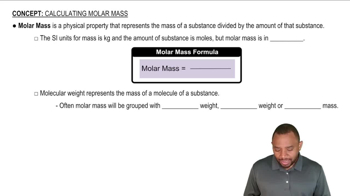
Molar mass is the mass of one mole of a substance, typically expressed in grams per mole (g/mol). For water (H2O), the molar mass is approximately 18.02 g/mol, calculated by adding the atomic masses of its constituent elements: hydrogen (H) and oxygen (O). Understanding molar mass is essential for converting between grams and moles in chemical calculations.
Video consigliato:
Percorso guidato
02:11
Molar Mass Concept

Avogadro's Number

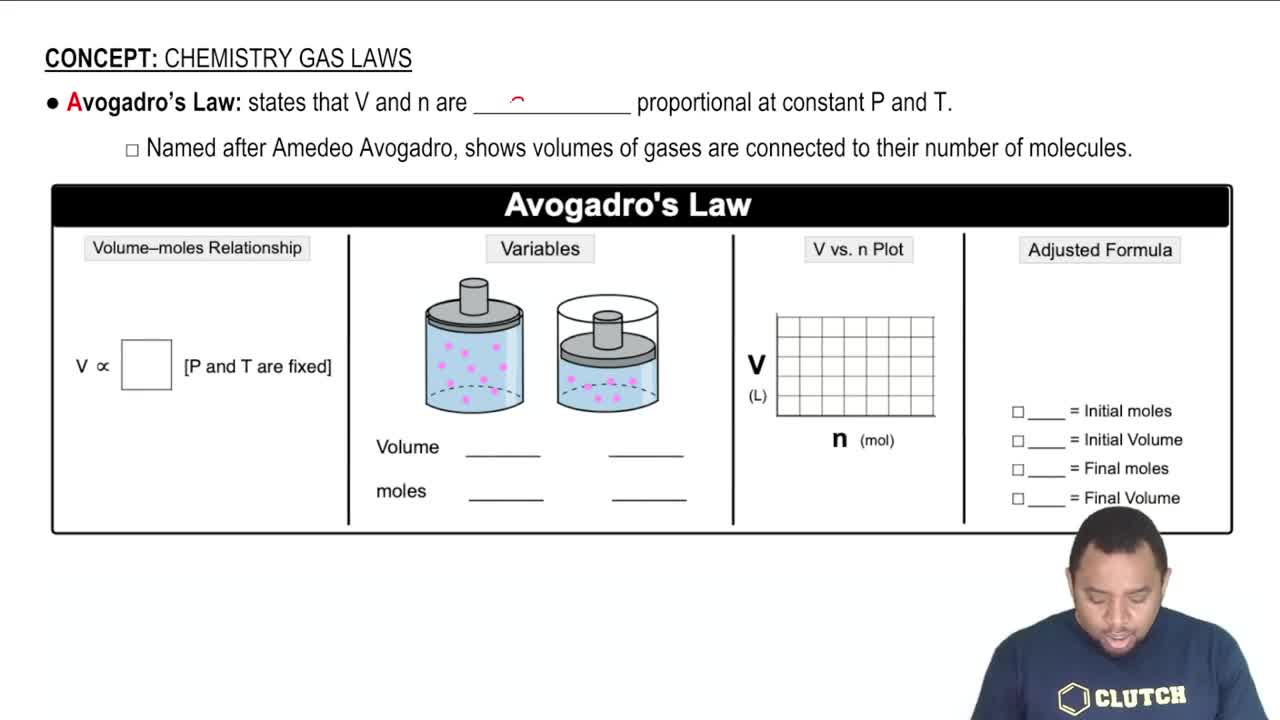
Avogadro's number, approximately 6.022 x 10^23, is the number of particles (atoms, molecules, etc.) in one mole of a substance. This constant allows chemists to relate the macroscopic scale of substances (grams) to the microscopic scale (molecules). It is crucial for determining how many molecules are present in a given mass of a substance.
Video consigliato:

Mole Concept

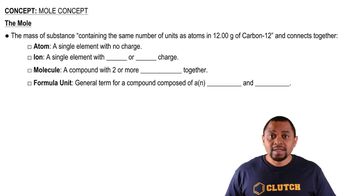
The mole concept is a fundamental principle in chemistry that provides a bridge between the atomic and macroscopic worlds. It allows chemists to count entities at the atomic scale by weighing them at the macroscopic scale. By using the mole, one can easily convert between the mass of a substance and the number of molecules it contains, facilitating various chemical calculations.
Video consigliato: