Ch.3 - Molecules and Compounds
Tro - Chemistry: A Molecular Approach 5th Edition
Tro5th EditionChemistry: A Molecular ApproachISBN: 9780134874371Non è quello che usi tu?Cambia libro di testo
Capitolo 3, Problema 51a

Name each acid. a. HI(aq) b. HNO3(aq) c. H2CO3(aq)

Guida verificata passo dopo passo
1
1. Identify the type of acid. In this case, HI(aq) is a binary acid because it consists of two elements: hydrogen and iodine.
2. For binary acids, the name starts with 'hydro-', followed by the root of the nonmetal's name, and ends with '-ic acid'.
3. The nonmetal in this acid is iodine. The root of 'iodine' is 'iod'.
4. Therefore, the name of the acid HI(aq) is 'hydroiodic acid'.

Risposta video verificata per un problema simile:

Questa soluzione video è stata consigliata dai nostri tutor come utile per risolvere questo problema.
Durata del video:
2m

Concetti chiave

Ecco i concetti essenziali che devi comprendere per rispondere correttamente alla domanda.

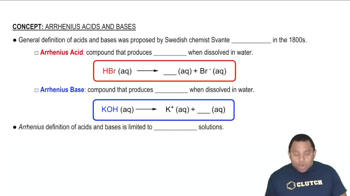
Acids and Bases

Acids are substances that can donate protons (H+) in a solution, while bases can accept protons. The strength of an acid is determined by its ability to dissociate in water, producing H+ ions. Understanding the properties of acids and bases is fundamental in identifying and naming them.
Video consigliato:
Percorso guidato
02:00
Arrhenius Acids and Bases

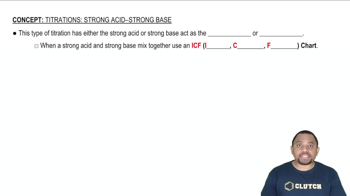
Strong Acids

Strong acids are those that completely dissociate in water, releasing all of their protons. Hydroiodic acid (HI) is a strong acid, meaning it ionizes fully in aqueous solution. Recognizing strong acids helps in predicting their behavior in chemical reactions and their naming conventions.
Video consigliato:
Percorso guidato
01:09
Strong Acid-Strong Base Titration

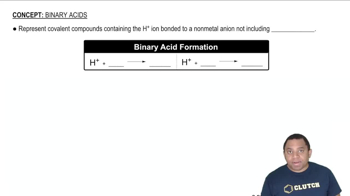
Nomenclature of Acids

The nomenclature of acids involves specific rules for naming based on their composition. Binary acids, like HI, are named using the prefix 'hydro-' followed by the root of the nonmetal and the suffix '-ic.' This systematic approach is essential for accurately identifying and naming various acids in chemistry.
Video consigliato: