Ch.4 - Chemical Reactions and Chemical Quantities
Tro - Chemistry: A Molecular Approach 5th Edition
Tro5th EditionChemistry: A Molecular ApproachISBN: 9780134874371Non è quello che usi tu?Cambia libro di testo
Capitolo 4, Problema 51

Is the following formulation of a task correct? If not, please correct it: Complete and balance each combustion reaction equation. a. S(s) + O2(g) → b. C3H6(g) + O2(g) → c. Ca(s) + O2(g) → d. C5H12S(l) + O2(g) →

Guida verificata passo dopo passo
1
Identify the reactants and products in each combustion reaction. Combustion typically involves a substance reacting with oxygen to form oxides.
For each reaction, write the unbalanced chemical equation. For example, for reaction (a), write S(s) + O_2(g) → SO_2(g).
Balance each equation by adjusting the coefficients to ensure the same number of each type of atom on both sides of the equation. Start with the most complex molecule.
Check that the number of atoms for each element is equal on both sides of the equation. Adjust coefficients as necessary to achieve balance.
Verify that the balanced equation follows the law of conservation of mass, meaning the total mass of reactants equals the total mass of products.

Concetti chiave

Ecco i concetti essenziali che devi comprendere per rispondere correttamente alla domanda.

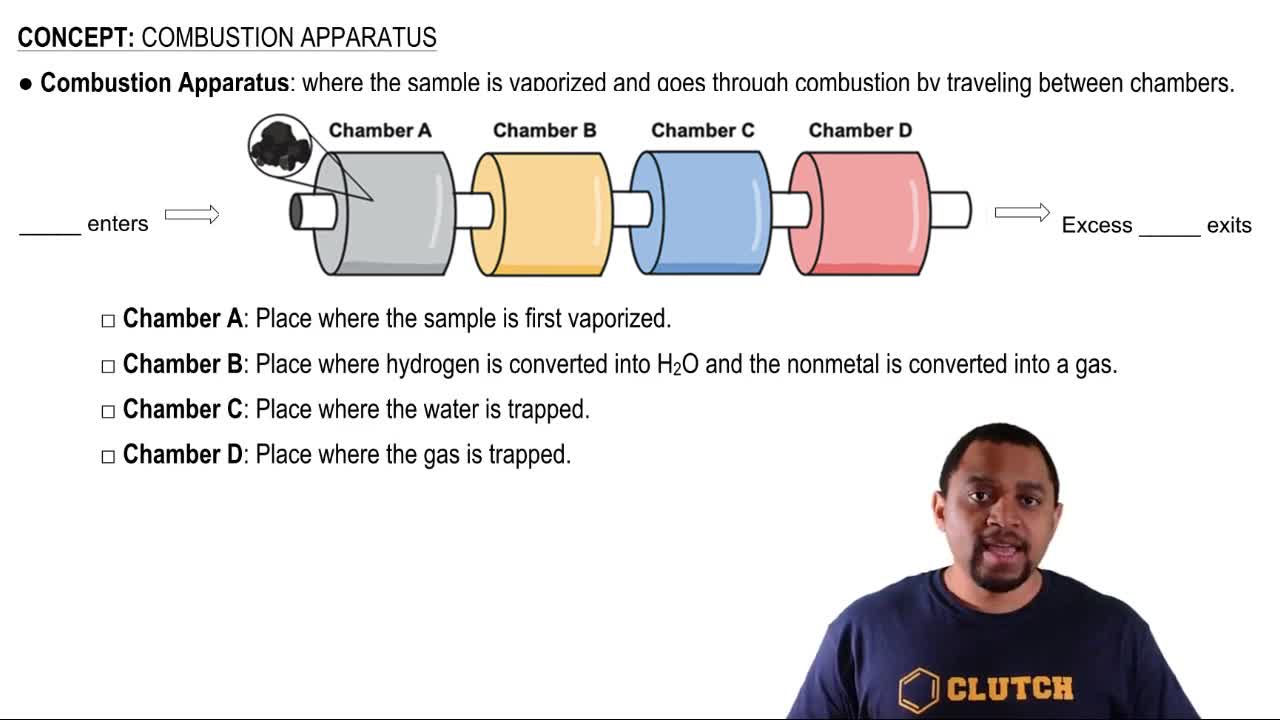
Combustion Reactions

Combustion reactions are chemical processes in which a substance reacts rapidly with oxygen, producing heat and light. Typically, these reactions involve hydrocarbons or other organic compounds, resulting in products like carbon dioxide and water. Understanding the general form of combustion reactions is essential for balancing them correctly.
Video consigliato:
Percorso guidato
02:24
Combustion Apparatus

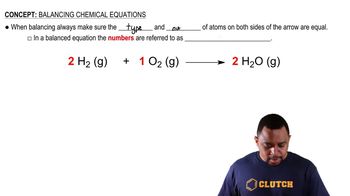
Balancing Chemical Equations

Balancing chemical equations involves ensuring that the number of atoms for each element is the same on both sides of the equation. This is achieved by adjusting coefficients in front of the reactants and products. A balanced equation reflects the law of conservation of mass, which states that matter cannot be created or destroyed in a chemical reaction.
Video consigliato:
Percorso guidato
01:32
Balancing Chemical Equations

State Symbols in Chemical Reactions

State symbols indicate the physical state of the reactants and products in a chemical reaction. Common symbols include (s) for solid, (l) for liquid, (g) for gas, and (aq) for aqueous solutions. These symbols provide important information about the conditions under which the reaction occurs and can influence the balancing of the equation.
Video consigliato:
Percorso guidato
03:17
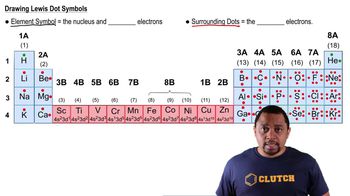
Lewis Dot Symbols
Pratica correlata
Domanda del libro di testo

Write the balanced chemical equation for the reaction of solid potassium with liquid water.

633
views
Domanda del libro di testo

Urea (CH4N2O) is a common fertilizer that is synthesized by the reaction of ammonia (NH3) with carbon dioxide: 2 NH3(aq) + CO2(aq) → CH4N2O(aq) + H2O(l) In an industrial synthesis of urea, a chemist combines 136.4 kg of ammonia with 211.4 kg of carbon dioxide and obtains 168.4 kg of urea. Determine the limiting reactant, theoretical yield of urea, and percent yield for the reaction.

8570
views
1
comments
Domanda del libro di testo

Write the balanced chemical equation for the reaction of solid strontium with iodine gas.

974
views
Domanda del libro di testo

Write the balanced chemical equation for the reaction of solid lithium with liquid water.

862
views
Domanda del libro di testo

Magnesium oxide can be made by heating magnesium metal in the presence of oxygen. The balanced equation for the reaction is: 2 Mg(s) + O2(g) → 2 MgO(s) When 10.1 g of Mg reacts with 10.5 g O2, 11.9 g MgO is collected. Determine the limiting reactant, theoretical yield, and percent yield for the reaction.

10217
views
Domanda del libro di testo

Many computer chips are manufactured from silicon, which occurs in nature as SiO2. When SiO2 is heated to melting, it reacts with solid carbon to form liquid silicon and carbon monoxide gas. In an industrial preparation of silicon, 155.8 kg of SiO2 reacts with 78.3 kg of carbon to produce 66.1 kg of silicon. Determine the percent yield for the reaction.

1703
views