Ch.4 - Chemical Reactions and Chemical Quantities
Tro - Chemistry: A Molecular Approach 5th Edition
Tro5th EditionChemistry: A Molecular ApproachISBN: 9780134874371Non è quello che usi tu?Cambia libro di testo
Capitolo 4, Problema 45

Iron(III) oxide reacts with carbon monoxide according to the equation: Fe2O3(s) + 3 CO(g) → 2 Fe(s) + 3 CO2(g) A reaction mixture initially contains 22.55 g Fe2O3 and 14.78 g CO. Once the reaction has occurred as completely as possible, what mass (in g) of the excess reactant remains?

Guida verificata passo dopo passo
1
Calculate the molar mass of Fe_2O_3 and CO using the periodic table.
Convert the given masses of Fe_2O_3 and CO to moles by dividing by their respective molar masses.
Determine the limiting reactant by comparing the mole ratio of Fe_2O_3 to CO from the balanced equation with the mole ratio from the initial amounts.
Use the stoichiometry of the reaction to calculate how much of the excess reactant is consumed by the limiting reactant.
Subtract the moles of the excess reactant consumed from the initial moles to find the remaining moles, then convert this back to grams using the molar mass.

Risposta video verificata per un problema simile:

Questa soluzione video è stata consigliata dai nostri tutor come utile per risolvere questo problema.
Durata del video:
3m

Concetti chiave

Ecco i concetti essenziali che devi comprendere per rispondere correttamente alla domanda.

Stoichiometry

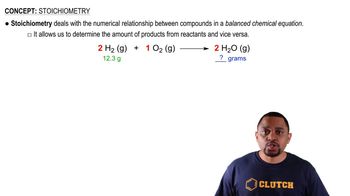
Stoichiometry is the calculation of reactants and products in chemical reactions based on the balanced chemical equation. It allows us to determine the proportions of substances involved in a reaction, which is essential for identifying limiting and excess reactants. In this case, stoichiometry will help us calculate how much of each reactant is consumed and how much remains after the reaction.
Video consigliato:
Percorso guidato
01:16
Stoichiometry Concept

Limiting Reactant

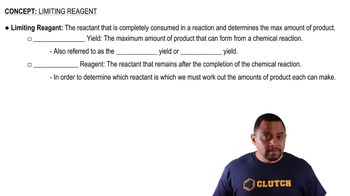
The limiting reactant is the substance that is completely consumed first in a chemical reaction, thus determining the maximum amount of product that can be formed. Identifying the limiting reactant is crucial for calculating the amounts of products and any excess reactants left over. In this reaction, we will need to find out which reactant, Fe2O3 or CO, limits the formation of iron and carbon dioxide.
Video consigliato:
Percorso guidato
01:30
Limiting Reagent Concept

Excess Reactant

The excess reactant is the substance that remains after the reaction has gone to completion, as it is not completely consumed. Understanding the concept of excess reactants is important for calculating how much of a reactant is left over after the reaction. In this scenario, once we identify the limiting reactant, we can determine the mass of the excess reactant that remains unreacted.
Video consigliato:
Percorso guidato
01:30
Limiting Reagent Concept
Pratica correlata
Domanda del libro di testo

For the reaction shown, calculate the theoretical yield of product (in grams) for each initial amount of reactants. 2 Al(s) + 3 Cl2(g) → 2 AlCl3(s) c. 0.235 g Al, 1.15 g Cl2

643
views
Domanda del libro di testo

Elemental phosphorus reacts with chlorine gas according to the equation: P4(s) + 6 Cl2( g) → 4 PCl3(l) A reaction mixture initially contains 45.69 g P4 and 131.3 g Cl2. Once the reaction has occurred as completely as possible, what mass (in g) of the excess reactant remains?

3657
views
1
rank
Domanda del libro di testo

For the reaction shown, calculate the theoretical yield of the product (in grams) for each initial amount of reactants. Ti(s) + 2 F2( g) → TiF4(s) c. 0.233 g Ti, 0.288 g F2

3446
views
1
rank
Domanda del libro di testo

Urea (CH4N2O) is a common fertilizer that is synthesized by the reaction of ammonia (NH3) with carbon dioxide: 2 NH3(aq) + CO2(aq) → CH4N2O(aq) + H2O(l) In an industrial synthesis of urea, a chemist combines 136.4 kg of ammonia with 211.4 kg of carbon dioxide and obtains 168.4 kg of urea. Determine the limiting reactant, theoretical yield of urea, and percent yield for the reaction.

8570
views
1
comments
Domanda del libro di testo

Magnesium oxide can be made by heating magnesium metal in the presence of oxygen. The balanced equation for the reaction is: 2 Mg(s) + O2(g) → 2 MgO(s) When 10.1 g of Mg reacts with 10.5 g O2, 11.9 g MgO is collected. Determine the limiting reactant, theoretical yield, and percent yield for the reaction.

10217
views