Ch.4 - Chemical Reactions and Chemical Quantities
Tro - Chemistry: A Molecular Approach 5th Edition
Tro5th EditionChemistry: A Molecular ApproachISBN: 9780134874371Non è quello che usi tu?Cambia libro di testo
Capitolo 4, Problema 20a

Write the balanced chemical equation for each reaction. a. Solid copper reacts with solid sulfur to form solid copper(I) sulfide.

Guida verificata passo dopo passo
1
Identify the reactants and products in the reaction. The reactants are solid copper (Cu) and solid sulfur (S), and the product is solid copper(I) sulfide (Cu2S).
Write the unbalanced chemical equation by placing the reactants on the left side and the product on the right side of the equation: Cu + S → Cu2S.
Balance the equation by adjusting the coefficients to ensure that the number of atoms for each element is the same on both sides of the equation. Start by balancing the elements that appear in only one reactant and one product.
Since copper appears in the form of Cu2S in the product, place a coefficient of 2 in front of Cu in the reactants to balance the copper atoms: 2 Cu + S → Cu2S.
Check that all elements are balanced. In this case, sulfur is already balanced with one atom on each side of the equation, so the balanced chemical equation is: 2 Cu + S → Cu2S.

Risposta video verificata per un problema simile:

Questa soluzione video è stata consigliata dai nostri tutor come utile per risolvere questo problema.
Durata del video:
1m

Concetti chiave

Ecco i concetti essenziali che devi comprendere per rispondere correttamente alla domanda.

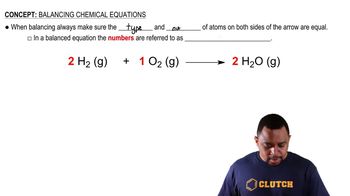
Balancing Chemical Equations

Balancing chemical equations involves ensuring that the number of atoms of each element is the same on both the reactant and product sides. This is based on the law of conservation of mass, which states that matter cannot be created or destroyed in a chemical reaction. Each side of the equation must have equal numbers of each type of atom, which often requires adjusting coefficients in front of the chemical formulas.
Video consigliato:
Percorso guidato
01:32
Balancing Chemical Equations

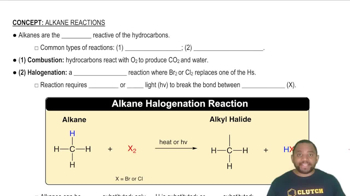
Chemical Reaction Types

Chemical reactions can be classified into various types, including synthesis, decomposition, single replacement, and double replacement. The reaction described in the question is a synthesis reaction, where two or more reactants combine to form a single product. Understanding the type of reaction helps in predicting the products and writing the correct balanced equation.
Video consigliato:
Percorso guidato
02:25
Common Types of Alkane Reactions

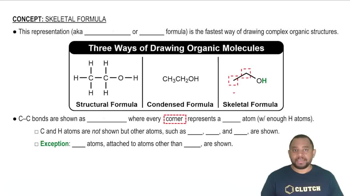
Chemical Formulas

Chemical formulas represent the composition of compounds, indicating the types and numbers of atoms involved. For example, copper(I) sulfide is represented as Cu2S, where 'Cu' stands for copper and 'S' for sulfur. Knowing how to interpret and write chemical formulas is essential for accurately representing the substances involved in a reaction and for balancing the equation correctly.
Video consigliato:
Percorso guidato
02:26
Skeletal Formula