Domanda del libro di testo
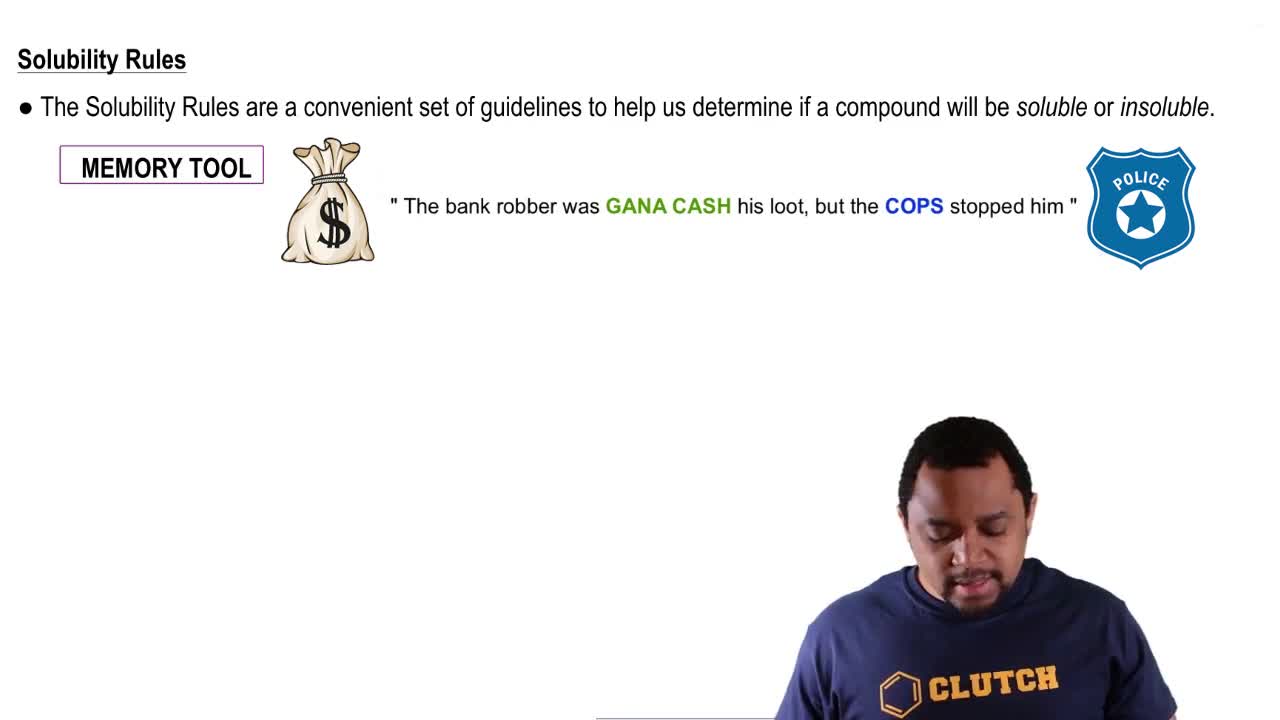
Determine whether each compound is soluble or insoluble. If the compound is soluble, list the ions present in solution. a. AgI b. Cu3(PO4)2 c. CoCO3 d. K3PO4
1637
views
 Tro 5th EditionCh.5 - Introduction to Solutions and Aqueous SolutionsProblema 43
 Guida verificata passo dopo passo
 01:11
01:11
 00:28
00:28 01:32
01:32Determine whether each compound is soluble or insoluble. If the compound is soluble, list the ions present in solution. a. AgI b. Cu3(PO4)2 c. CoCO3 d. K3PO4
Determine whether each compound is soluble or insoluble. If the compound is soluble, list the ions present in solution. a. AgNO3 b. Pb(C2H3O2)2 c. KNO3 d. (NH4)2S
Complete and balance each equation. If no reaction occurs, write 'NO REACTION.' c. CrBr2(aq) + Na2CO3(aq) →
Classify each compound as a strong electrolyte or nonelectrolyte. a. MgBr2 b. C12H22O11 c. Na2CO3 d. KOH
Complete and balance each equation. If no reaction occurs, write 'NO REACTION.' b. KCl(aq) + CaS(aq) →
Complete and balance each equation. If no reaction occurs, write 'NO REACTION.' a. LiI(aq) + BaS(aq)