The density of a 20.0% by mass ethylene glycol (C2H6O2) solution in water is 1.03 g/mL. Find the molarity of the solution.
Ch.5 - Introduction to Solutions and Aqueous Solutions
Tro5th EditionChemistry: A Molecular ApproachISBN: 9780134874371Non è quello che usi tu?Cambia libro di testo
Tutti i libri di testo
Tro 5th Edition
Ch.5 - Introduction to Solutions and Aqueous Solutions
Problema 65c,d
Tro 5th Edition
Ch.5 - Introduction to Solutions and Aqueous Solutions
Problema 65c,dCapitolo 5, Problema 65c,d
Determine whether each reaction is a redox reaction. For each redox reaction, identify the oxidizing agent and the reducing agent. c. Pb(NO3)2(aq) + Na2SO4(aq) → PbSO4(s) + 2 NaNO3(aq) d. HBr(aq) + KOH(aq) → H2O(l) + KBr(aq)
Guida verificata passo dopo passo1
Step 1: Understand the concept of a redox reaction. A redox reaction involves the transfer of electrons between two species. It consists of two half-reactions: oxidation (loss of electrons) and reduction (gain of electrons).
Step 2: Assign oxidation states to each element in the reactants and products for reaction c: Pb(NO_3)_2(aq) + Na_2SO_4(aq) \(\rightarrow\) PbSO_4(s) + 2 NaNO_3(aq).
Step 3: Compare the oxidation states of each element before and after the reaction in c. If there is a change in oxidation states, it is a redox reaction. If not, it is not a redox reaction.
Step 4: Repeat steps 2 and 3 for reaction d: HBr(aq) + KOH(aq) \(\rightarrow\) H_2O(l) + KBr(aq).
Step 5: For any reaction identified as a redox reaction, determine the oxidizing agent (species that is reduced) and the reducing agent (species that is oxidized).

Risposta video verificata per un problema simile:
Questa soluzione video è stata consigliata dai nostri tutor come utile per risolvere questo problema.
Durata del video:
2mConcetti chiave
Ecco i concetti essenziali che devi comprendere per rispondere correttamente alla domanda.
Redox Reactions
Redox reactions, or reduction-oxidation reactions, involve the transfer of electrons between two species. In these reactions, one substance is oxidized (loses electrons) while another is reduced (gains electrons). Identifying redox reactions requires analyzing changes in oxidation states of the elements involved.
Video consigliato:
Percorso guidato
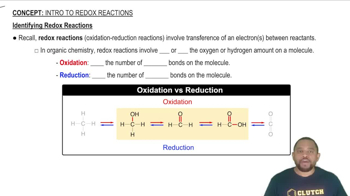
Identifying Redox Reactions
Oxidizing and Reducing Agents
The oxidizing agent is the substance that gains electrons and is reduced in a redox reaction, while the reducing agent is the substance that loses electrons and is oxidized. Understanding these roles is crucial for identifying which species undergo changes in oxidation state during the reaction.
Video consigliato:
Percorso guidato
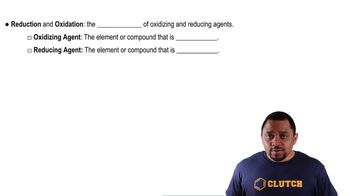
Oxidizing and Reducing Agents
Precipitation Reactions
Precipitation reactions occur when two aqueous solutions react to form an insoluble solid, known as a precipitate. In the given reactions, it is important to recognize that not all reactions are redox; some may simply involve the formation of a precipitate without electron transfer.
Video consigliato:
Percorso guidato
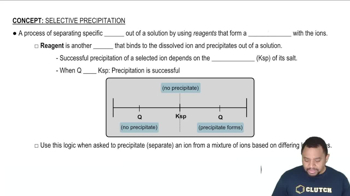
Selective Precipitation
Pratica correlata
Domanda del libro di testo
3239
views
2
rank
Domanda del libro di testo
What is the oxidation state of Cl in each ion? a. ClO- b. ClO2- c. ClO3- d. ClO4-
1345
views
1
rank
Domanda del libro di testo
Determine whether each reaction is a redox reaction. For each redox reaction, identify the oxidizing agent and the reducing agent. a. 4 Li(s) + O2(g) → 2 Li2O(s) b. Mg(s) + Fe2+(aq) → Mg2+(aq) + Fe(s)
2114
views
Domanda del libro di testo
Find the percent by mass of sodium chloride in a 1.35 M NaCl solution. The density of the solution is 1.05 g/mL.
2722
views
3
rank
Domanda del libro di testo
What is the oxidation state of Cr in each compound? c. Cr2O3
607
views
Domanda del libro di testo
Determine whether each reaction is a redox reaction. For each redox reaction, identify the oxidizing agent and the reducing agent. a. Al(s) + 3 Ag+(aq) → Al3+(aq) + 3 Ag(s) b. SO3(g) + H2O(l) → H2SO4(aq) c. Ba(s) + Cl2(g) → BaCl2(s) d. Mg(s) + Br2(l) → MgBr2(s)
498
views