
Ch.6 - Gases
Tro - Chemistry: A Molecular Approach 5th Edition
Tro5th EditionChemistry: A Molecular ApproachISBN: 9780134874371Non è quello che usi tu?Cambia libro di testo
Capitolo 6, Problema 82a

A flask at room temperature contains exactly equal amounts (in moles) of nitrogen and xenon. a. Which of the two gases exerts the greater partial pressure?

Guida verificata passo dopo passo
1
insert step 1> Understand that partial pressure is the pressure exerted by a single type of gas in a mixture of gases.
insert step 2> Recall Dalton's Law of Partial Pressures, which states that the total pressure of a gas mixture is the sum of the partial pressures of each individual gas.
insert step 3> Note that the partial pressure of a gas in a mixture is proportional to its mole fraction in the mixture.
insert step 4> Since the problem states that there are exactly equal amounts (in moles) of nitrogen and xenon, their mole fractions are equal.
insert step 5> Conclude that both gases exert the same partial pressure because they have the same mole fraction in the mixture.

Risposta video verificata per un problema simile:

Questa soluzione video è stata consigliata dai nostri tutor come utile per risolvere questo problema.
Durata del video:
2m

Concetti chiave

Ecco i concetti essenziali che devi comprendere per rispondere correttamente alla domanda.

Partial Pressure

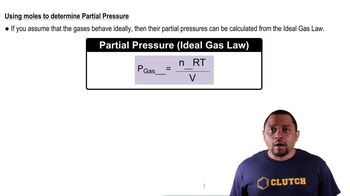
Partial pressure is the pressure that a single gas in a mixture would exert if it occupied the entire volume alone. According to Dalton's Law of Partial Pressures, the total pressure of a gas mixture is the sum of the partial pressures of each individual gas. Understanding this concept is crucial for determining how each gas contributes to the overall pressure in a container.
Video consigliato:
Percorso guidato
00:48
Partial Pressure Calculation

Ideal Gas Law

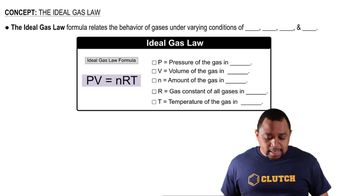
The Ideal Gas Law, represented as PV = nRT, relates the pressure (P), volume (V), number of moles (n), the ideal gas constant (R), and temperature (T) of a gas. This law helps predict the behavior of gases under various conditions. In this scenario, it can be used to compare the behavior of nitrogen and xenon, particularly their pressures at the same temperature and volume.
Video consigliato:
Percorso guidato
01:15
Ideal Gas Law Formula

Molar Mass and Density

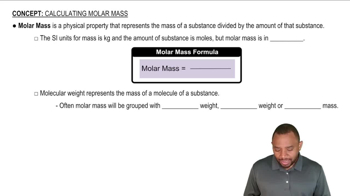
Molar mass is the mass of one mole of a substance, and it influences the density of gases. In this case, nitrogen (N2) has a lower molar mass compared to xenon (Xe), which means that at the same temperature and volume, nitrogen will have a higher number of moles per unit volume, leading to a greater partial pressure. Understanding the relationship between molar mass, density, and gas behavior is essential for this question.
Video consigliato:
Percorso guidato
02:11
Molar Mass Concept