The pressure on top of Mount Everest (29,029 ft) averages about 235 mmHg. Convert this pressure to each indicated unit. a. torr b. psi c. in Hg d. atm
Ch.6 - Gases
Tro5th EditionChemistry: A Molecular ApproachISBN: 9780134874371Non è quello che usi tu?Cambia libro di testo
Capitolo 6, Problema 28d
The world record for lowest pressure (at sea level) was 652.5 mmHg recorded inside Typhoon Tip on October 12, 1979, in the western Pacific Ocean. Convert this pressure to each indicated unit. d. psi
Guida verificata passo dopo passo1
Identify the given pressure in mmHg: 652.5 mmHg.
Recall the conversion factor between mmHg and psi: 1 atm = 760 mmHg and 1 atm = 14.696 psi.
Convert the pressure from mmHg to atm using the conversion factor: \( \text{Pressure in atm} = \frac{652.5 \text{ mmHg}}{760 \text{ mmHg/atm}} \).
Use the pressure in atm to convert to psi: \( \text{Pressure in psi} = \text{Pressure in atm} \times 14.696 \text{ psi/atm} \).
Perform the calculations to find the pressure in psi.

Risposta video verificata per un problema simile:
Questa soluzione video è stata consigliata dai nostri tutor come utile per risolvere questo problema.
Durata del video:
2mConcetti chiave
Ecco i concetti essenziali che devi comprendere per rispondere correttamente alla domanda.
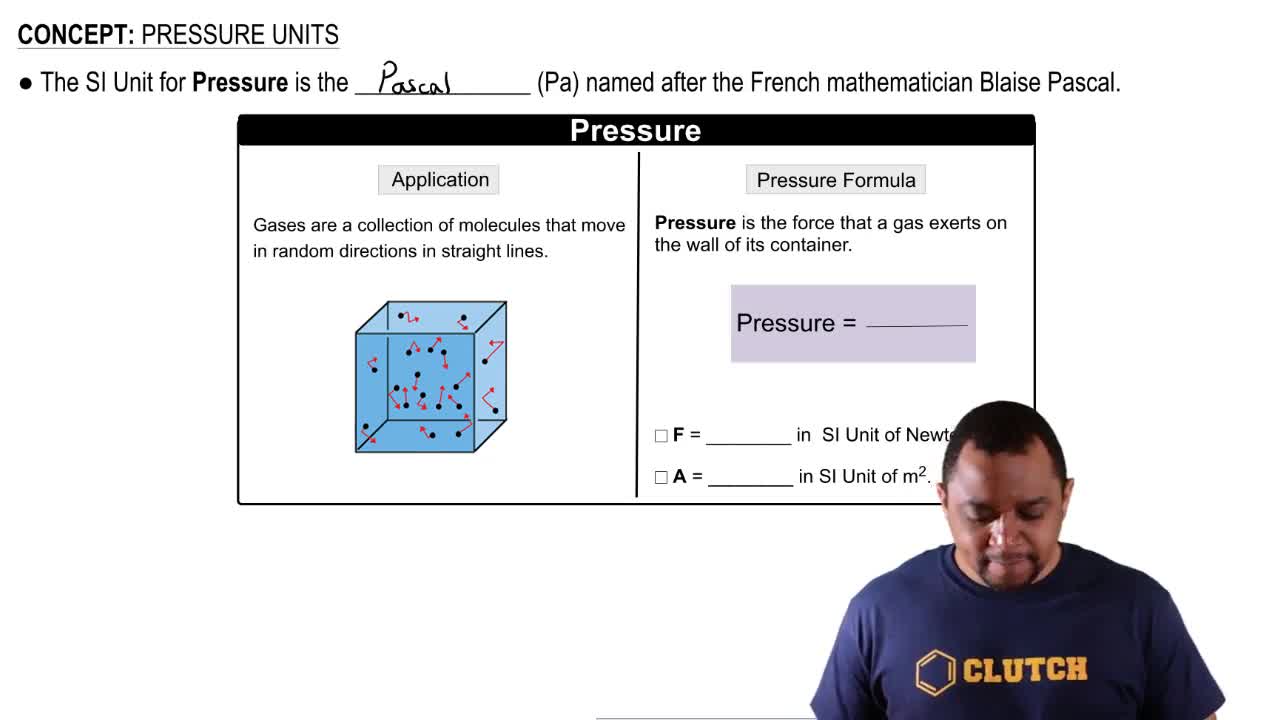
Pressure Units
Pressure is a measure of force applied per unit area and can be expressed in various units, including mmHg (millimeters of mercury), psi (pounds per square inch), and atm (atmospheres). Understanding these units is crucial for converting pressure values from one unit to another, as each unit reflects different scales and contexts of measurement.
Video consigliato:
Percorso guidato
Pressure Units
Conversion Factors
To convert between different pressure units, specific conversion factors are used. For example, 1 mmHg is approximately equal to 0.0193368 psi. Knowing these conversion factors allows for accurate calculations and comparisons of pressure measurements across different systems.
Video consigliato:
Percorso guidato
Conversion Factors
Ideal Gas Law
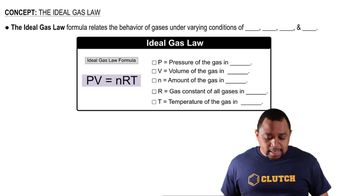
The Ideal Gas Law (PV=nRT) relates pressure (P), volume (V), temperature (T), and the number of moles (n) of a gas. While not directly required for unit conversion, understanding this law provides context for why pressure measurements are important in various scientific and engineering applications, particularly in understanding gas behavior under different conditions.
Video consigliato:
Percorso guidato
Ideal Gas Law Formula
Pratica correlata
Domanda del libro di testo
4565
views
1
rank
Domanda del libro di testo
A sample of gas has an initial volume of 5.6 L at a pressure of 735 mmHg. If the volume of the gas is increased to 9.4 L, what is its pressure?
1878
views
Domanda del libro di testo
Given a barometric pressure of 751.5 mmHg, calculate the pressure of each gas sample as indicated by the manometer.
(a)
3686
views
1
comments
Domanda del libro di testo
Given a barometric pressure of 751.5 mmHg, calculate the pressure of each gas sample as indicated by the manometer.
(b)
487
views
Domanda del libro di testo
The North American record for highest recorded barometric pressure is 31.85 in Hg, set in 1989 in Northway, Alaska. Convert this pressure to each indicated unit. a. mmHg
2946
views
Domanda del libro di testo
The world record for lowest pressure (at sea level) was 652.5 mmHg recorded inside Typhoon Tip on October 12, 1979, in the western Pacific Ocean. Convert this pressure to each indicated unit. b. atm
3090
views