Ch.6 - Gases
Tro - Chemistry: A Molecular Approach 5th Edition
Tro5th EditionChemistry: A Molecular ApproachISBN: 9780134874371Non è quello che usi tu?Cambia libro di testo
Capitolo 6, Problema 40

What is the pressure in a 15.0-L cylinder filled with 32.7 g of oxygen gas at a temperature of 302 K?

Guida verificata passo dopo passo
1
Identify the ideal gas law equation: \( PV = nRT \).
Calculate the number of moles \( n \) of oxygen gas using its molar mass (\( \text{O}_2 \) has a molar mass of approximately 32.00 g/mol): \( n = \frac{\text{mass}}{\text{molar mass}} \).
Substitute the given values into the ideal gas law equation: \( P = \frac{nRT}{V} \), where \( R \) is the ideal gas constant (0.0821 L·atm/mol·K).
Use the given volume \( V = 15.0 \) L, temperature \( T = 302 \) K, and the calculated moles \( n \) to solve for pressure \( P \).
Perform the calculation to find the pressure \( P \) in atmospheres.

Risposta video verificata per un problema simile:

Questa soluzione video è stata consigliata dai nostri tutor come utile per risolvere questo problema.
Durata del video:
5m

Concetti chiave

Ecco i concetti essenziali che devi comprendere per rispondere correttamente alla domanda.

Ideal Gas Law

The Ideal Gas Law is a fundamental equation in chemistry that relates the pressure, volume, temperature, and number of moles of a gas. It is expressed as PV = nRT, where P is pressure, V is volume, n is the number of moles, R is the ideal gas constant, and T is temperature in Kelvin. This law allows us to calculate one property of a gas if the others are known.
Video consigliato:
Percorso guidato
01:15
Ideal Gas Law Formula

Molar Mass

Molar mass is the mass of one mole of a substance, typically expressed in grams per mole (g/mol). For oxygen (O2), the molar mass is approximately 32.00 g/mol. Understanding molar mass is essential for converting grams of a substance to moles, which is necessary for using the Ideal Gas Law.
Video consigliato:
Percorso guidato
02:11
Molar Mass Concept

Gas Constant (R)

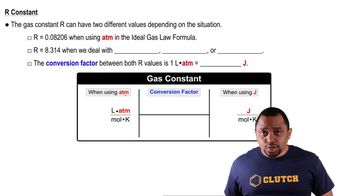
The gas constant (R) is a proportionality constant in the Ideal Gas Law, with a value of 0.0821 L·atm/(K·mol) when pressure is measured in atmospheres and volume in liters. It serves as a bridge between the physical properties of gases and their behavior under various conditions. Knowing the correct value of R is crucial for accurate calculations in gas law problems.
Video consigliato:
Percorso guidato
01:56
Gas Constant Values
Pratica correlata
Domanda del libro di testo

What is the temperature of 0.52 mol of gas at a pressure of 1.3 atm and a volume of 11.8 L?

1614
views

Domanda del libro di testo

An automobile tire has a maximum rating of 38.0 psi (gauge pressure). The tire is inflated (while cold) to a volume of 11.8 L and a gauge pressure of 36.0 psi at a temperature of 12.0 °C. On a hot day, the tire warms to 65.0 °C, and its volume expands to 12.2 L. Does the pressure in the tire exceed its maximum rating? (Note: The gauge pressure is the difference between the total pressure and atmospheric pressure. In this case, assume that atmospheric pressure is 14.7 psi.)

1711
views
Domanda del libro di testo

What volume is occupied by 12.5 g of argon gas at a pressure of 1.05 atm and a temperature of 322 K? Would the volume be different if the sample were 12.5 g of helium (under identical conditions)?

1838
views
1
comments
Domanda del libro di testo

What volume is occupied by 0.118 mol of helium gas at a pressure of 0.97 atm and a temperature of 305 K?

817
views
Domanda del libro di testo

What volume is occupied by 0.118 mol of helium gas at a pressure of 0.97 atm and a temperature of 305 K? Would the volume be different if the gas was argon (under the same conditions)?

1929
views
1
rank
Domanda del libro di testo

A weather balloon is inflated to a volume of 28.5 L at a pressure of 748 mmHg and a temperature of 28.0 °C. The balloon rises in the atmosphere to an altitude of approximately 25,000 ft, where the pressure is 385 mmHg and the temperature is -15.0 °C. Assuming the balloon can freely expand, calculate the volume of the balloon at this altitude.

6407
views
2
rank