Ch.7 - Thermochemistry
Tro - Chemistry: A Molecular Approach 5th Edition
Tro5th EditionChemistry: A Molecular ApproachISBN: 9780134874371Non è quello che usi tu?Cambia libro di testo
Capitolo 7, Problema 77c

For each generic reaction, determine the value of ΔH2 in terms of ΔH1.
c. A → B + 2 C ΔH1
1/2 B + C → 1/2 A ΔH2 = ?

Guida verificata passo dopo passo
1
Identify the stoichiometry of the reactions given. The first reaction is A → B + 2C with a heat change ΔH₁. The second reaction is 1/2 B + C → 1/2 A with a heat change ΔH₂.
To find ΔH₂, we need to reverse and adjust the stoichiometry of the first reaction to match the second reaction. Reversing the first reaction gives B + 2C → A, and the heat change for this reversed reaction would be -ΔH₁.
Adjust the coefficients of the reversed reaction to match those of the second reaction. Divide all coefficients in the reversed reaction by 2 to get 1/2 B + C → 1/2 A.
Since the coefficients of all substances in the reversed reaction are halved, the heat change for this new reaction will also be half of -ΔH₁, which is -1/2 ΔH₁.
Thus, ΔH₂ for the reaction 1/2 B + C → 1/2 A is -1/2 ΔH₁.

Risposta video verificata per un problema simile:

Questa soluzione video è stata consigliata dai nostri tutor come utile per risolvere questo problema.
Durata del video:
5m

Concetti chiave

Ecco i concetti essenziali che devi comprendere per rispondere correttamente alla domanda.

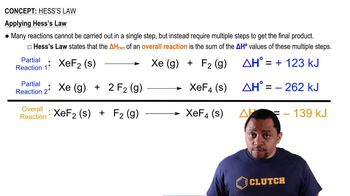
Hess's Law

Hess's Law states that the total enthalpy change for a chemical reaction is the sum of the enthalpy changes for the individual steps of the reaction, regardless of the pathway taken. This principle allows us to calculate the enthalpy change for a reaction by combining known enthalpy changes of related reactions.
Video consigliato:

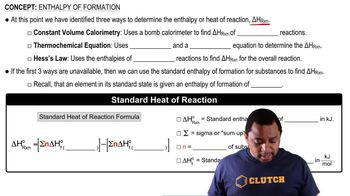
Enthalpy Change (ΔH)

Enthalpy change (ΔH) is a measure of the heat content of a system at constant pressure. It indicates whether a reaction is exothermic (releases heat, ΔH < 0) or endothermic (absorbs heat, ΔH > 0). Understanding ΔH is crucial for predicting the energy changes associated with chemical reactions.
Video consigliato:
Percorso guidato
02:34
Enthalpy of Formation

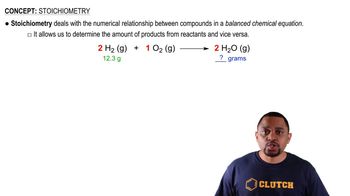
Stoichiometry in Reactions

Stoichiometry involves the quantitative relationships between the reactants and products in a chemical reaction. It allows us to relate the amounts of substances consumed and produced, which is essential for calculating enthalpy changes when reactions are manipulated or combined.
Video consigliato:
Percorso guidato
01:16
Stoichiometry Concept
Pratica correlata
Domanda del libro di testo

For each generic reaction, determine the value of ΔH2 in terms of ΔH1.

a. A + B → 2 C ΔH1

2 C→ A + B ΔH2 = ?

339
views
Domanda del libro di testo

For each generic reaction, determine the value of ΔH2 in terms of ΔH1.

b. A + 1/2 B → C ΔH1

2 A + B → 2 C ΔH2 = ?

1909
views
Domanda del libro di testo

Calculate ΔHrxn for the reaction:

Fe2O3(s) + 3 CO(g) → 2 Fe(s) + 3 CO2(g)

Use the following reactions and given ΔH's:

2 Fe(s) + 3/2 O2(g) → Fe2O3(s) ΔH = –824.2 kJ

CO(g) + 1/2 O2(g) → CO2(g) ΔH = –282.7 kJ

2714
views
Domanda del libro di testo

Instant cold packs used to ice athletic injuries on the field contain ammonium nitrate and water separated by a thin plastic divider. When the divider is broken, the ammonium nitrate dissolves according to the endothermic reaction: NH4NO3(s) → NH4+(aq) + NO3– (aq) In order to measure the enthalpy change for this reaction, 1.25 g of NH4NO3 is dissolved in enough water to make 25.0 mL of solution. The initial temperature is 25.8 °C and the final temperature (after the solid dissolves) is 21.9 °C. Calculate the change in enthalpy for the reaction in kJ. (Use 1.0 g/mL as the density of the solution and 4.18 J/g•°C as the specific heat capacity.)

3188
views
1
comments
Domanda del libro di testo

Consider the generic reaction:

A + 2 B → C + 3 D ΔH = 155 kJ

Determine the value of ΔH for each related reaction.

a. 3 A + 6 B → 3 C + 9 D

b. C + 3 D → A + 2 B

c. 1/2 C + 3/2 D → 1/2 A + B

1781
views
Domanda del libro di testo

Calculate ΔHrxn for the reaction:

CaO(s) + CO2(g) → CaCO3(s)

Use the following reactions and given ΔH's:

Ca(s) + CO2(g) + 1/2 O2(g) → CaCO3(s) ΔH = –812.8 kJ

2 Ca(s) + O2(g) → 2 CaO(s) ΔH = –1269.8 kJ

2152
views