Ch.7 - Thermochemistry
Tro - Chemistry: A Molecular Approach 5th Edition
Tro5th EditionChemistry: A Molecular ApproachISBN: 9780134874371Non è quello che usi tu?Cambia libro di testo
Capitolo 7, Problema 56

The change in internal energy for the combustion of 1.0 mol of octane at a pressure of 1.0 atm is 5084.3 kJ. If the change in enthalpy is 5074.1 kJ, how much work is done during the combustion?

Guida verificata passo dopo passo
1
Identify the given values: Change in internal energy (\(\Delta U\)) is 5084.3 kJ, and change in enthalpy (\(\Delta H\)) is 5074.1 kJ.
Recall the relationship between change in internal energy, change in enthalpy, and work done at constant pressure: \(\Delta U = \Delta H - P\Delta V\), where \(P\Delta V\) represents the work done.
Rearrange the formula to solve for work done (\(P\Delta V\)): \(P\Delta V = \Delta H - \Delta U\).
Substitute the given values into the rearranged equation: \(P\Delta V = 5074.1 \, \text{kJ} - 5084.3 \, \text{kJ}\).
Calculate the work done by solving the equation from the previous step.

Risposta video verificata per un problema simile:

Questa soluzione video è stata consigliata dai nostri tutor come utile per risolvere questo problema.
Durata del video:
1m

Concetti chiave

Ecco i concetti essenziali che devi comprendere per rispondere correttamente alla domanda.

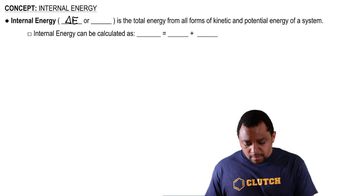
Internal Energy

Internal energy is the total energy contained within a system, including kinetic and potential energy at the molecular level. It is a state function, meaning it depends only on the current state of the system, not on how it reached that state. In chemical reactions, changes in internal energy can be calculated by considering the heat exchanged and the work done on or by the system.
Video consigliato:
Percorso guidato
00:40
Internal Energy

Enthalpy

Enthalpy is a thermodynamic quantity that represents the total heat content of a system at constant pressure. It is defined as the sum of the internal energy and the product of pressure and volume (H = U + PV). The change in enthalpy during a reaction indicates the heat absorbed or released, which is crucial for understanding energy changes in chemical processes.
Video consigliato:
Percorso guidato
02:34
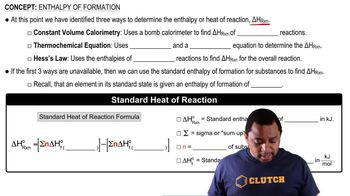
Enthalpy of Formation

Work in Thermodynamics

In thermodynamics, work is defined as the energy transferred when a force is applied over a distance. For chemical reactions occurring at constant pressure, the work done can be calculated using the equation W = -PΔV, where P is the pressure and ΔV is the change in volume. Understanding the relationship between work, internal energy, and enthalpy is essential for analyzing energy changes during reactions.
Video consigliato:
Percorso guidato
01:18
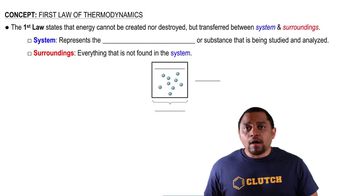
First Law of Thermodynamics