
Domanda del libro di testo
Charcoal is primarily carbon. Determine the mass of CO2 produced by burning enough carbon (in the form of charcoal) to produce 5.00×10² kJ of heat. C(s) + O2(g) → CO2(g) ΔH°rxn = –393.5 kJ
3374
views
 Guida verificata passo dopo passo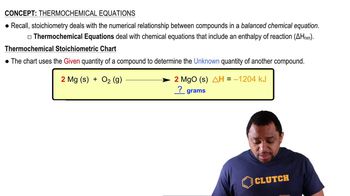
 01:13
01:13
 02:19
02:19 01:16
01:16Charcoal is primarily carbon. Determine the mass of CO2 produced by burning enough carbon (in the form of charcoal) to produce 5.00×10² kJ of heat. C(s) + O2(g) → CO2(g) ΔH°rxn = –393.5 kJ
A 32.5-g iron rod, initially at 22.7 °C, is submerged into an unknown mass of water at 63.2 °C, in an insulated container. The final temperature of the mixture upon reaching thermal equilibrium is 59.5 °C. What is the mass of the water?
A silver block, initially at 58.5 °C, is submerged into 100.0 g of water at 24.8 °C, in an insulated container. The final temperature of the mixture upon reaching thermal equilibrium is 26.2 °C. What is the mass of the silver block?
Nitromethane (CH3NO2) burns in air to produce significant amounts of heat. 2 CH3NO2(l) + 3/2 O2(g) → 2 CO2(g) + 3 H2O(l) + N2(g) ΔH°rxn = –1418 kJ How much heat is produced by the complete reaction of 5.56 kg of nitromethane?
Titanium reacts with iodine to form titanium(III) iodide, emitting heat. 2 Ti(s) + 3 I2(g) → 2 TiI3(s) ΔH°rxn = –839 kJ Determine the mass of titanium that react if 1.55×10³ kJ of heat is emitted by the reaction.
What mass of natural gas (CH4) must burn to emit 267 kJ of heat? CH4(g) + 2 O2(g) → CO2(g) + 2 H2O(g) ΔH°rxn = –802.3 kJ