Ch.7 - Thermochemistry
Tro - Chemistry: A Molecular Approach 5th Edition
Tro5th EditionChemistry: A Molecular ApproachISBN: 9780134874371Non è quello che usi tu?Cambia libro di testo
Capitolo 7, Problema 69

Two substances, A and B, initially at different temperatures, come into contact and reach thermal equilibrium. The mass of substance A is 6.15 g and its initial temperature is 20.5 °C. The mass of substance B is 25.2 g and its initial temperature is 52.7 °C. The final temperature of both substances at thermal equilibrium is 46.7 °C. If the specific heat capacity of substance B is 1.17 J/g•°C, what is the specific heat capacity of substance A?

Guida verificata passo dopo passo
1
Identify the principle of conservation of energy, which states that the heat lost by substance B will be equal to the heat gained by substance A.
Write the formula for heat transfer: \( q = m \cdot c \cdot \Delta T \), where \( q \) is the heat transferred, \( m \) is the mass, \( c \) is the specific heat capacity, and \( \Delta T \) is the change in temperature.
Calculate the change in temperature for each substance: \( \Delta T_A = T_{\text{final}} - T_{\text{initial, A}} \) and \( \Delta T_B = T_{\text{final}} - T_{\text{initial, B}} \).
Set up the equation for heat transfer: \( m_A \cdot c_A \cdot \Delta T_A = - (m_B \cdot c_B \cdot \Delta T_B) \). Note that the heat gained by A is equal to the negative of the heat lost by B.
Rearrange the equation to solve for the specific heat capacity of substance A: \( c_A = - \frac{m_B \cdot c_B \cdot \Delta T_B}{m_A \cdot \Delta T_A} \).

Risposta video verificata per un problema simile:

Questa soluzione video è stata consigliata dai nostri tutor come utile per risolvere questo problema.

Concetti chiave

Ecco i concetti essenziali che devi comprendere per rispondere correttamente alla domanda.

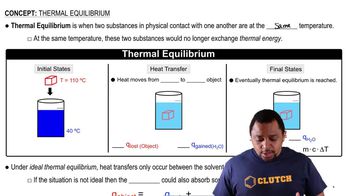
Thermal Equilibrium

Thermal equilibrium occurs when two substances at different temperatures come into contact and exchange heat until they reach the same temperature. At this point, the heat lost by the hotter substance equals the heat gained by the cooler substance, resulting in no net heat flow between them. This principle is fundamental in calorimetry and helps in understanding heat transfer in physical systems.
Video consigliato:
Percorso guidato
02:35
Thermal Equilibrium

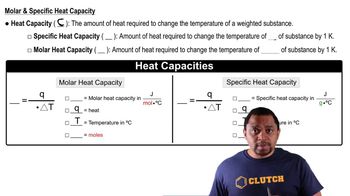
Specific Heat Capacity

Specific heat capacity is the amount of heat required to raise the temperature of one gram of a substance by one degree Celsius. It is a material-specific property that indicates how much energy a substance can store or release as its temperature changes. Knowing the specific heat capacities of substances allows for calculations involving heat transfer and temperature changes in thermal processes.
Video consigliato:

Heat Transfer Equation

The heat transfer equation, often expressed as Q = mcΔT, relates the heat (Q) absorbed or released by a substance to its mass (m), specific heat capacity (c), and the change in temperature (ΔT). This equation is crucial for solving problems involving thermal equilibrium, as it allows for the calculation of unknown variables, such as specific heat capacity, when the other parameters are known.
Video consigliato: