Ch.7 - Thermochemistry
Tro - Chemistry: A Molecular Approach 5th Edition
Tro5th EditionChemistry: A Molecular ApproachISBN: 9780134874371Non è quello che usi tu?Cambia libro di testo
Capitolo 7, Problema 88a

Use standard enthalpies of formation to calculate ΔH°rxn for each reaction. a. 2 H2S(g) + 3 O2(g) → 2 H2O(l) + 2 SO2(g)

Guida verificata passo dopo passo
1
Identify the standard enthalpy of formation (ΔH°f) for each compound involved in the reaction. These values are typically found in a table of standard enthalpies of formation.
Write the balanced chemical equation: 2 H2S(g) + 3 O2(g) → 2 H2O(l) + 2 SO2(g).
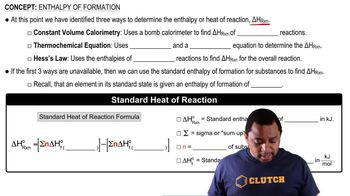
Apply Hess's Law, which states that the change in enthalpy for a reaction is the sum of the enthalpy changes for each step of the reaction. Use the formula: ΔH°rxn = Σ ΔH°f(products) - Σ ΔH°f(reactants).
Calculate the sum of the standard enthalpies of formation for the products: 2(ΔH°f of H2O(l)) + 2(ΔH°f of SO2(g)).
Calculate the sum of the standard enthalpies of formation for the reactants: 2(ΔH°f of H2S(g)) + 3(ΔH°f of O2(g)). Note that the ΔH°f for O2(g) is zero because it is in its standard state.

Risposta video verificata per un problema simile:

Questa soluzione video è stata consigliata dai nostri tutor come utile per risolvere questo problema.
Durata del video:
4m

Concetti chiave

Ecco i concetti essenziali che devi comprendere per rispondere correttamente alla domanda.

Enthalpy of Formation

The standard enthalpy of formation (ΔH°f) is the change in enthalpy when one mole of a compound is formed from its elements in their standard states. It is a crucial value used in thermodynamics to calculate the heat changes in chemical reactions. Each substance has a specific ΔH°f, which can be found in tables, and is essential for determining the overall enthalpy change of a reaction.
Video consigliato:
Percorso guidato
02:34
Enthalpy of Formation

Hess's Law

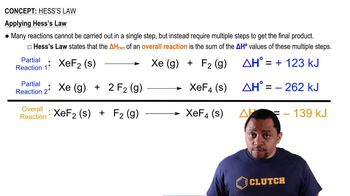
Hess's Law states that the total enthalpy change for a reaction is the same, regardless of the number of steps taken to achieve the reaction. This principle allows for the calculation of ΔH°rxn by summing the enthalpy changes of individual steps, using the standard enthalpies of formation of reactants and products. It emphasizes the state function nature of enthalpy, making it independent of the pathway taken.
Video consigliato:

Reaction Stoichiometry

Reaction stoichiometry involves the quantitative relationships between reactants and products in a chemical reaction, as represented by the balanced chemical equation. Understanding stoichiometry is essential for calculating the amounts of substances involved and for applying the standard enthalpies of formation correctly. It ensures that the coefficients in the balanced equation are used to scale the ΔH°f values appropriately when calculating ΔH°rxn.
Video consigliato:
Percorso guidato
01:16
Stoichiometry Concept