Ch.8 - The Quantum-Mechanical Model of the Atom
Tro - Chemistry: A Molecular Approach 5th Edition
Tro5th EditionChemistry: A Molecular ApproachISBN: 9780134874371Non è quello che usi tu?Cambia libro di testo
Capitolo 8, Problema 55

An electron has an uncertainty in its position of 552 pm. What is the uncertainty in its velocity?

Guida verificata passo dopo passo
1
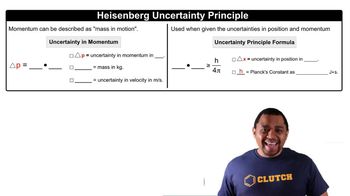
Step 1: Understand the problem. This problem is based on Heisenberg's Uncertainty Principle, which states that it is impossible to simultaneously measure the exact position and momentum (or velocity) of a particle. The principle can be mathematically expressed as Δx * Δp ≥ h/4π, where Δx is the uncertainty in position, Δp is the uncertainty in momentum, h is Planck's constant, and π is a mathematical constant.
Step 2: Convert the given uncertainty in position from picometers (pm) to meters (m) because the SI unit for position is meter. 1 pm = 1e-12 m.
Step 3: Rearrange the Heisenberg's Uncertainty Principle equation to solve for the uncertainty in momentum (Δp). Δp = h/(4π*Δx).
Step 4: Calculate the uncertainty in momentum using the converted uncertainty in position and the value of Planck's constant (h = 6.62607015 × 10^-34 m^2 kg / s).
Step 5: Finally, calculate the uncertainty in velocity (Δv) using the relation Δp = m*Δv, where m is the mass of the electron (9.10938356 × 10^-31 kilograms). Rearrange the equation to solve for Δv: Δv = Δp/m.

Risposta video verificata per un problema simile:

Questa soluzione video è stata consigliata dai nostri tutor come utile per risolvere questo problema.

Concetti chiave

Ecco i concetti essenziali che devi comprendere per rispondere correttamente alla domanda.

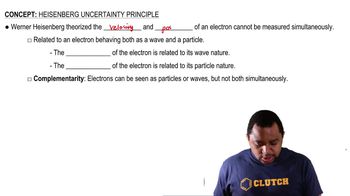
Heisenberg Uncertainty Principle

The Heisenberg Uncertainty Principle states that it is impossible to simultaneously know both the exact position and exact momentum (which includes velocity) of a particle. This principle highlights a fundamental limit to measurement at the quantum level, indicating that the more precisely one property is measured, the less precisely the other can be known.
Video consigliato:
Percorso guidato
01:09
Heisenberg Uncertainty Principle

Quantum Mechanics

Quantum mechanics is the branch of physics that deals with the behavior of particles at the atomic and subatomic levels. It introduces concepts such as wave-particle duality and quantization of energy, which are essential for understanding the behavior of electrons and other particles in terms of probabilities rather than certainties.
Video consigliato:
Percorso guidato
01:
Introduction to Quantum Mechanics

Uncertainty in Measurements

Uncertainty in measurements refers to the inherent limitations in measuring physical quantities. In the context of the Heisenberg Uncertainty Principle, the uncertainty in position and momentum (or velocity) can be quantitatively related, allowing for calculations that predict the degree of uncertainty in one variable based on the known uncertainty in the other.
Video consigliato:
Percorso guidato
02:05
Uncertainty Principle Formula