Ch.8 - The Quantum-Mechanical Model of the Atom
Tro - Chemistry: A Molecular Approach 5th Edition
Tro5th EditionChemistry: A Molecular ApproachISBN: 9780134874371Non è quello che usi tu?Cambia libro di testo
Capitolo 8, Problema 79

Ionization involves completely removing an electron from an atom. How much energy is required to ionize a hydrogen atom in its ground (or lowest energy) state? What wavelength of light contains enough energy in a single photon to ionize a hydrogen atom?

Guida verificata passo dopo passo
1
Identify the energy required to ionize a hydrogen atom in its ground state, which is the energy difference between the ground state and the point where the electron is completely removed (ionization energy).
Use the formula for the energy of an electron in a hydrogen atom: \(E_n = -\frac{13.6 \text{ eV}}{n^2}\), where \(n\) is the principal quantum number. For the ground state, \(n=1\).
Calculate the ionization energy by finding the difference between the energy at \(n=1\) and \(n=\infty\) (where the electron is completely removed).
Convert the ionization energy from electron volts (eV) to joules if necessary, using the conversion factor \(1 \text{ eV} = 1.602 \times 10^{-19} \text{ J}\).
Determine the wavelength of light that corresponds to this energy using the equation \(E = \frac{hc}{\lambda}\), where \(h\) is Planck's constant (\(6.626 \times 10^{-34} \text{ J s}\)), \(c\) is the speed of light (\(3.00 \times 10^8 \text{ m/s}\)), and \(\lambda\) is the wavelength.

Risposta video verificata per un problema simile:

Questa soluzione video è stata consigliata dai nostri tutor come utile per risolvere questo problema.
Durata del video:
4m

Concetti chiave

Ecco i concetti essenziali che devi comprendere per rispondere correttamente alla domanda.

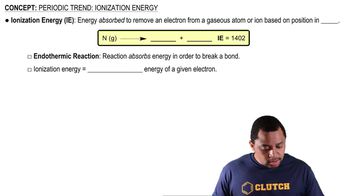
Ionization Energy

Ionization energy is the amount of energy required to remove an electron from an atom in its gaseous state. For hydrogen, this energy is specifically the energy needed to remove the single electron from its ground state, which is approximately 1312 kJ/mol. Understanding this concept is crucial for calculating the energy needed for ionization and for determining the corresponding wavelength of light.
Video consigliato:
Percorso guidato
01:19
Ionization Energy

Photon Energy and Wavelength

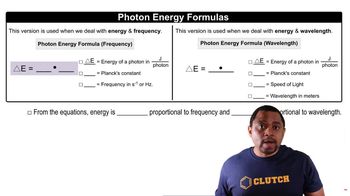
The energy of a photon is inversely related to its wavelength, described by the equation E = hc/λ, where E is energy, h is Planck's constant, c is the speed of light, and λ is the wavelength. To ionize a hydrogen atom, the energy of a photon must equal or exceed the ionization energy. This relationship allows us to calculate the wavelength of light that can provide sufficient energy for ionization.
Video consigliato:
Percorso guidato
01:40
Photon Energy Formulas

Ground State of Hydrogen

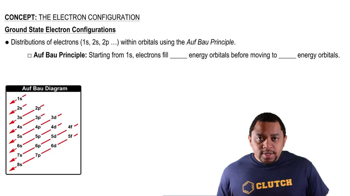
The ground state of hydrogen refers to the lowest energy level of the hydrogen atom, where the electron is closest to the nucleus. In this state, the electron is in the 1s orbital, and any energy input must be sufficient to overcome the attractive force between the electron and the nucleus to achieve ionization. Understanding the ground state is essential for determining the specific energy requirements for ionization.
Video consigliato:
Percorso guidato
01:32
Ground State Electron Configurations