Ch.9 - Periodic Properties of the Elements
Tro - Chemistry: A Molecular Approach 5th Edition
Tro5th EditionChemistry: A Molecular ApproachISBN: 9780134874371Non è quello che usi tu?Cambia libro di testo
Capitolo 9, Problema 57b

If core electrons completely shielded valence electrons from nuclear charge (i.e., if each core electron reduced nuclear charge by 1 unit) and if valence electrons did not shield one another from nuclear charge at all, what would be the effective nuclear charge experienced by the valence electrons of each atom? b. Ca

Guida verificata passo dopo passo
1
Identify the atomic number of calcium (Ca), which is 20.
Determine the number of core electrons in calcium. Calcium has an electron configuration of [Ar] 4s^2, so it has 18 core electrons (the electrons in the argon core).
Apply the concept of effective nuclear charge (Z_eff), which is calculated as Z_eff = Z - S, where Z is the atomic number and S is the number of core electrons.
Substitute the values into the formula: Z_eff = 20 (atomic number of Ca) - 18 (number of core electrons).
Conclude that the effective nuclear charge experienced by the valence electrons of calcium is the result of the calculation from the previous step.

Risposta video verificata per un problema simile:

Questa soluzione video è stata consigliata dai nostri tutor come utile per risolvere questo problema.
Durata del video:
2m

Concetti chiave

Ecco i concetti essenziali che devi comprendere per rispondere correttamente alla domanda.

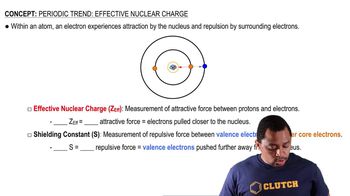
Effective Nuclear Charge (Z_eff)

Effective nuclear charge (Z_eff) is the net positive charge experienced by valence electrons in an atom. It accounts for the actual nuclear charge (the number of protons) minus the shielding effect of core electrons. In this scenario, if each core electron reduces the nuclear charge by 1 unit, Z_eff can be calculated by subtracting the number of core electrons from the total nuclear charge.
Video consigliato:
Percorso guidato
01:51
Effective Nuclear Charge

Shielding Effect

The shielding effect refers to the phenomenon where inner (core) electrons repel valence electrons, reducing the full attractive force of the nucleus on these outer electrons. In this question, it is assumed that core electrons completely shield valence electrons, meaning that each core electron effectively cancels out one unit of nuclear charge, simplifying the calculation of Z_eff.
Video consigliato:
Percorso guidato
02:31
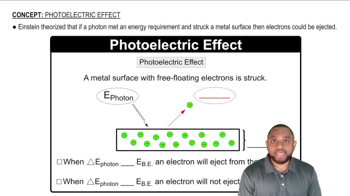
Photoelectric Effect

Valence Electrons

Valence electrons are the outermost electrons of an atom and are primarily responsible for chemical bonding and reactivity. In the context of this question, understanding the number of valence electrons in calcium (Ca) is crucial, as it determines how they interact with the effective nuclear charge and influences the atom's chemical properties.
Video consigliato:
Percorso guidato
02:12
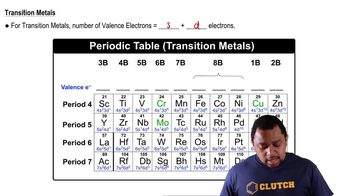
Transition Metals Valence Electrons
Pratica correlata
Domanda del libro di testo

Which experience a greater effective nuclear charge: the valence electrons in beryllium or the valence electrons in nitrogen? Why?

2134
views
Domanda del libro di testo

If core electrons completely shielded valence electrons from nuclear charge (i.e., if each core electron reduced nuclear charge by 1 unit) and if valence electrons did not shield one another from nuclear charge at all, what would be the effective nuclear charge experienced by the valence electrons of each atom? a. K

629
views
Domanda del libro di testo

In Section 3.6, we estimated the effective nuclear charge on beryllium's valence electrons to be slightly greater than 2+. What would a similar treatment predict for the effective nuclear charge on boron's valence electrons? Would you expect the effective nuclear charge to be different for boron's 2s electrons compared to its 2p electron? In what way? (Hint: Consider the shape of the 2p orbital compared to that of the 2s orbital.)

1059
views
1
rank
Domanda del libro di testo

Choose the larger atom in each pair. a. Al or In b. Si or N c. P or Pb d. Si or Cl

1732
views
1
rank
Domanda del libro di testo

If core electrons completely shielded valence electrons from nuclear charge (i.e., if each core electron reduced nuclear charge by 1 unit) and if valence electrons did not shield one another from nuclear charge at all, what would be the effective nuclear charge experienced by the valence electrons of each atom? c. O d. C

2895
views
1
rank
Domanda del libro di testo

Arrange the atoms according to decreasing effective nuclear charge experienced by their valence electrons: S, Mg, Al, Si.

1692
views