You have cracked a secret code that uses elemental symbols to spell words. The code uses numbers to designate the elemental symbols. Each number is the sum of the atomic number and the highest principal quantum number of the highest occupied orbital of the element whose symbol is to be used. The message may be written forward or backward. Decode the following messages: a. 10, 12, 58, 11, 7, 44, 63, 66
Ch.9 - Periodic Properties of the Elements
Tro5th EditionChemistry: A Molecular ApproachISBN: 9780134874371Non è quello che usi tu?Cambia libro di testo
Capitolo 9, Problema 99
The elements with atomic numbers 35 and 53 have similar chemical properties. Based on their electronic configurations, predict the atomic number of a heavier element that also should share these chemical properties.
Guida verificata passo dopo passo1
Identify the elements with atomic numbers 35 and 53. These are bromine (Br) and iodine (I), respectively.
Recognize that elements with similar chemical properties are in the same group (column) of the periodic table. Bromine and iodine are both halogens, found in Group 17.
Understand that elements in the same group have similar valence electron configurations, which is why they exhibit similar chemical properties.
To find a heavier element with similar properties, look for the next element in Group 17 below iodine. This will have a higher atomic number.
Determine the atomic number of the next element in Group 17 after iodine, which is astatine (At) with atomic number 85.

Risposta video verificata per un problema simile:
Questa soluzione video è stata consigliata dai nostri tutor come utile per risolvere questo problema.
Durata del video:
6mConcetti chiave
Ecco i concetti essenziali che devi comprendere per rispondere correttamente alla domanda.
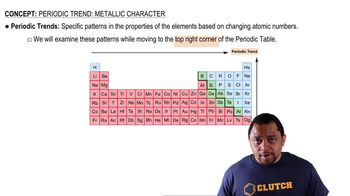
Periodic Trends
Periodic trends refer to the patterns observed in the properties of elements as you move across or down the periodic table. Elements in the same group (column) often exhibit similar chemical properties due to their similar valence electron configurations. Understanding these trends helps predict the behavior of elements based on their position in the periodic table.
Video consigliato:
Percorso guidato
Periodic Trends
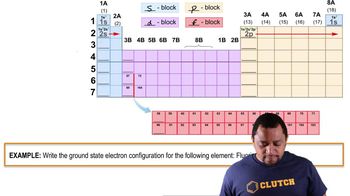
Electronic Configuration
Electronic configuration describes the distribution of electrons in an atom's orbitals. It is crucial for determining an element's chemical properties, as the arrangement of electrons, particularly in the outermost shell, influences how an element interacts with others. For elements with atomic numbers 35 (Bromine) and 53 (Iodine), their configurations indicate they belong to the halogen group, which is characterized by similar reactivity.
Video consigliato:
Percorso guidato
Electron Configuration Example
Halogens
Halogens are a group of elements in Group 17 of the periodic table, known for their high reactivity and tendency to form salts with metals. The halogens include fluorine, chlorine, bromine, iodine, and astatine. Elements in this group share similar chemical properties due to their similar electronic configurations, particularly having seven valence electrons, which drives their reactivity and bonding behavior.
Video consigliato:
Percorso guidato
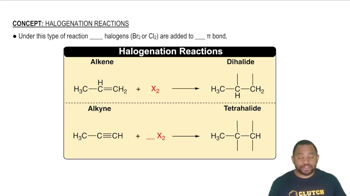
Halogenation Reactions
Pratica correlata
Domanda del libro di testo
2960
views
Domanda del libro di testo
The first ionization energy of sodium is 496 kJ/mol. Use Coulomb's law to estimate the average distance between the sodium nucleus and the 3s electron. How does this distance compare to the atomic radius of sodium? Explain the difference.
3534
views
Domanda del libro di testo
Use Coulomb's law to calculate the ionization energy in kJ>mol of an atom composed of a proton and an electron separated by 100.00 pm. What wavelength of light has sufficient energy to ionize the atom?
2938
views
