Ch.9 - Periodic Properties of the Elements
Tro - Chemistry: A Molecular Approach 5th Edition
Tro5th EditionChemistry: A Molecular ApproachISBN: 9780134874371Non è quello che usi tu?Cambia libro di testo
Capitolo 9, Problema 51b

Which outer electron configuration would you expect to belong to a reactive nonmetal? a. ns2 b. ns2np6 c. ns2np5 d. ns2np2

Guida verificata passo dopo passo
1
Identify the characteristics of a reactive nonmetal. Reactive nonmetals typically have high electronegativity and a strong tendency to gain electrons to achieve a stable electron configuration.
Consider the electron configurations provided: a. ns^2, b. ns^2np^6, c. ns^2np^5, d. ns^2np^2.
Recall that a stable electron configuration is often a full outer shell, which is ns^2np^6, corresponding to noble gases that are not reactive.
Recognize that a configuration of ns^2np^5 indicates one electron short of a full p subshell, making it highly reactive as it tends to gain one electron to achieve stability.
Conclude that the electron configuration ns^2np^5 is characteristic of a reactive nonmetal, as it is one electron away from achieving a stable noble gas configuration.

Risposta video verificata per un problema simile:

Questa soluzione video è stata consigliata dai nostri tutor come utile per risolvere questo problema.

Concetti chiave

Ecco i concetti essenziali che devi comprendere per rispondere correttamente alla domanda.

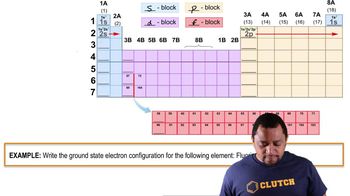
Electron Configuration

Electron configuration describes the distribution of electrons in an atom's orbitals. It is represented using the notation of subshells (s, p, d, f) and their respective electron counts. Understanding electron configuration is crucial for predicting an element's chemical properties, including its reactivity.
Video consigliato:
Percorso guidato
01:33
Electron Configuration Example

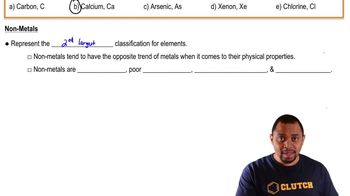
Reactivity of Nonmetals

Nonmetals are elements that typically gain electrons during chemical reactions, leading to the formation of anions. Their reactivity is largely influenced by their outer electron configuration, particularly the number of valence electrons. Nonmetals with nearly full outer shells tend to be more reactive as they seek to achieve a stable electron configuration.
Video consigliato:
Percorso guidato
01:12
Nonmetal Properties

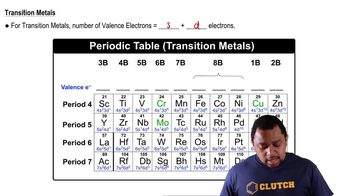
Valence Electrons

Valence electrons are the electrons in the outermost shell of an atom and are responsible for an element's chemical behavior. The number of valence electrons determines how an element interacts with others, including its tendency to gain, lose, or share electrons. For nonmetals, having five or more valence electrons typically indicates a higher reactivity.
Video consigliato:
Percorso guidato
02:12
Transition Metals Valence Electrons