Ch.9 - Periodic Properties of the Elements
Tro - Chemistry: A Molecular Approach 5th Edition
Tro5th EditionChemistry: A Molecular ApproachISBN: 9780134874371Non è quello che usi tu?Cambia libro di testo
Capitolo 9, Problema 42c,d

Write the full orbital diagram for each element. c. Ne d. He

Guida verificata passo dopo passo
1
1. Identify the atomic number of the element. The atomic number of Neon (Ne) is 10. This means there are 10 electrons in a neutral atom of Neon.
2. Start filling the orbitals according to the Aufbau principle, which states that electrons fill the lowest energy orbitals first. The order of filling is 1s, 2s, 2p, 3s, 3p, 4s, 3d, 4p, and so on.
3. Fill the 1s orbital first. Each orbital can hold a maximum of 2 electrons. So, the 1s orbital will have 2 electrons.
4. Next, fill the 2s orbital with 2 electrons. Now, you have placed 4 electrons and you have 6 more to place.
5. Finally, fill the 2p orbital with the remaining 6 electrons. The 2p orbital can hold a maximum of 6 electrons. So, the 2p orbital will have 6 electrons. Now, all 10 electrons have been placed.

Risposta video verificata per un problema simile:

Questa soluzione video è stata consigliata dai nostri tutor come utile per risolvere questo problema.
Durata del video:
2m

Concetti chiave

Ecco i concetti essenziali che devi comprendere per rispondere correttamente alla domanda.

Orbital Diagrams

Orbital diagrams visually represent the distribution of electrons in an atom's orbitals. Each orbital can hold a maximum of two electrons with opposite spins, and the diagram uses arrows to indicate the presence and spin of electrons. Understanding how to construct these diagrams is essential for predicting the electron configuration of elements.
Video consigliato:
Percorso guidato
01:16
Electron Orbital Diagrams

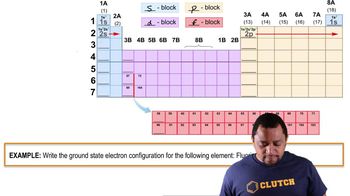
Electron Configuration

Electron configuration describes the arrangement of electrons in an atom's orbitals, following the principles of the Aufbau principle, Pauli exclusion principle, and Hund's rule. For neon (Ne), which has 10 electrons, the electron configuration is 1s² 2s² 2p⁶, indicating that the first two electrons fill the 1s orbital, followed by the 2s and 2p orbitals.
Video consigliato:
Percorso guidato
01:33
Electron Configuration Example

Noble Gases

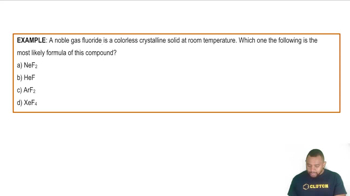
Noble gases, such as neon, are elements in Group 18 of the periodic table known for their full valence electron shells, making them chemically inert. Neon has a complete outer shell with eight electrons, which contributes to its stability and lack of reactivity. Understanding the properties of noble gases helps in grasping the significance of electron configurations in chemical behavior.
Video consigliato:
Percorso guidato
00:44
Noble Gas Compounds Example