Ch.1 - Matter, Measurement & Problem Solving
Tro - Chemistry: A Molecular Approach 6th Edition
Tro6th EditionChemistry: A Molecular ApproachISBN: 9780137832217Non è quello che usi tu?Cambia libro di testo
Capitolo 1, Problema 102

A gas can holds 25.0 gal of gasoline. Express this quantity in cm3.

Guida verificata passo dopo passo
1
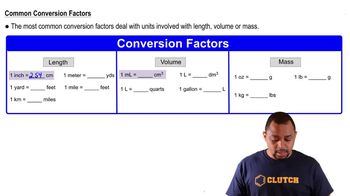
Identify the conversion factors needed: 1 gallon = 3.78541 liters and 1 liter = 1000 cm^3.
Convert gallons to liters using the conversion factor: multiply 25.0 gallons by 3.78541 liters per gallon.
Convert liters to cubic centimeters (cm^3) using the conversion factor: multiply the result from the previous step by 1000 cm^3 per liter.
Ensure that units cancel appropriately in each step to confirm the conversion is set up correctly.
The final result will be the volume in cm^3 after performing the calculations.

Risposta video verificata per un problema simile:

Questa soluzione video è stata consigliata dai nostri tutor come utile per risolvere questo problema.
Durata del video:
59s

Concetti chiave

Ecco i concetti essenziali che devi comprendere per rispondere correttamente alla domanda.

Volume Conversion

Volume conversion involves changing a measurement from one unit to another, which is essential in chemistry for comparing quantities. In this case, converting gallons to cubic centimeters (cm³) requires knowing the conversion factor: 1 gallon is approximately 3,785.41 cm³. Understanding how to apply this conversion factor is crucial for accurately expressing the volume of gasoline in the desired unit.
Video consigliato:
Percorso guidato
02:38
Common Conversion Factors

Metric System

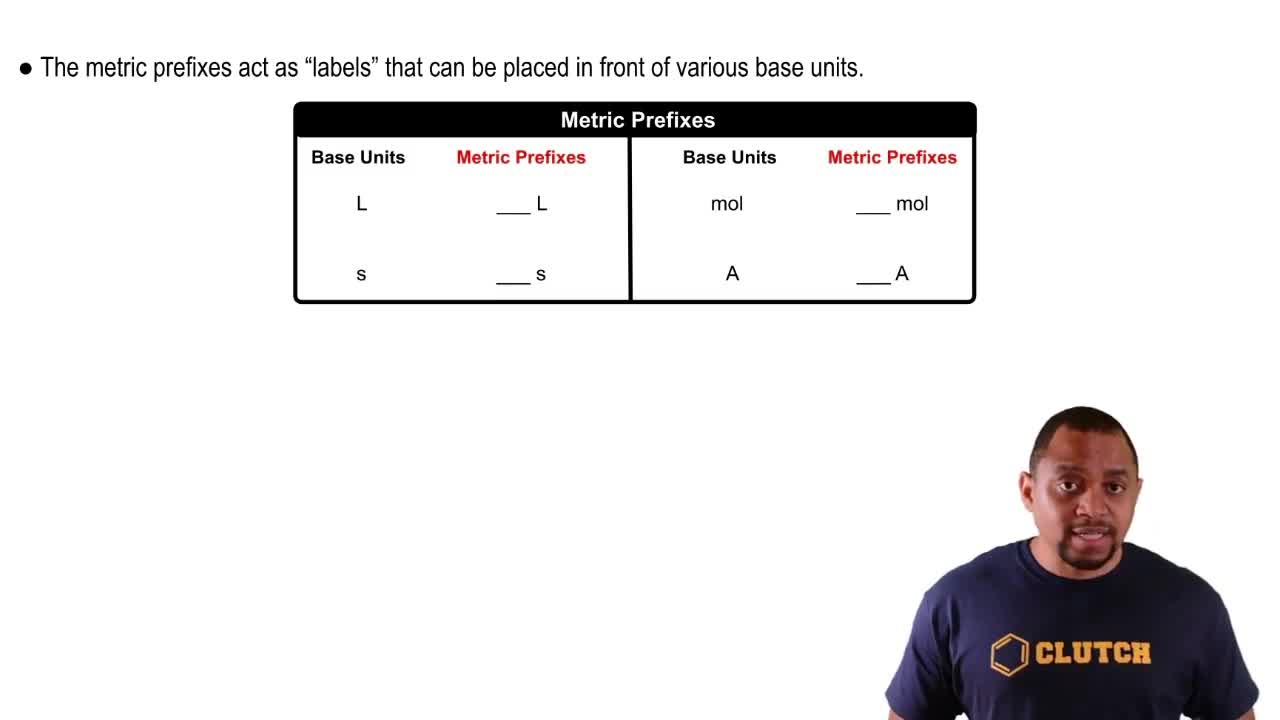
The metric system is a decimal-based system of measurement used globally in scientific contexts. It includes units such as liters, meters, and grams, with cubic centimeters (cm³) being a common unit for volume. Familiarity with the metric system is important for students in chemistry, as it facilitates easier calculations and comparisons of measurements across different substances.
Video consigliato:
Percorso guidato
01:16
Metric Prefixes Usage

Gasoline Density

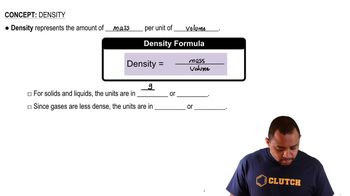
While not directly needed for the conversion in this question, understanding the density of gasoline can provide context for its volume. Gasoline typically has a density of about 0.74 g/cm³, which can be useful for further calculations involving mass or when considering the properties of gasoline in various chemical processes. Recognizing the relationship between volume, mass, and density is a fundamental concept in chemistry.
Video consigliato:
Percorso guidato
01:56
Density Concepts