Ch.1 - Matter, Measurement & Problem Solving
Tro - Chemistry: A Molecular Approach 6th Edition
Tro6th EditionChemistry: A Molecular ApproachISBN: 9780137832217Non è quello che usi tu?Cambia libro di testo
Capitolo 1, Problema 68

A titanium bicycle frame displaces 0.314 L of water and has a mass of 1.41 kg. What is the density of the titanium in g/cm3?

Guida verificata passo dopo passo
1
Convert the volume from liters to cubic centimeters. Since 1 L = 1000 cm³, multiply the volume in liters by 1000 to get the volume in cm³.
Convert the mass from kilograms to grams. Since 1 kg = 1000 g, multiply the mass in kilograms by 1000 to get the mass in grams.
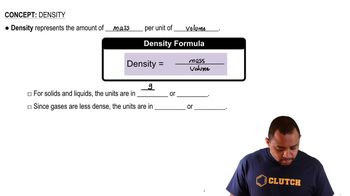
Use the formula for density: \( \text{Density} = \frac{\text{Mass}}{\text{Volume}} \).
Substitute the mass in grams and the volume in cm³ into the density formula.
Simplify the expression to find the density in g/cm³.

Risposta video verificata per un problema simile:

Questa soluzione video è stata consigliata dai nostri tutor come utile per risolvere questo problema.
Durata del video:
2m

Concetti chiave

Ecco i concetti essenziali che devi comprendere per rispondere correttamente alla domanda.

Density

Density is defined as the mass of an object divided by its volume. It is typically expressed in grams per cubic centimeter (g/cm³) in the context of solids and liquids. Understanding density is crucial for determining how much mass is contained in a given volume, which is essential for solving problems related to buoyancy and material properties.
Video consigliato:
Percorso guidato
01:56
Density Concepts

Volume Displacement

Volume displacement refers to the amount of fluid that is displaced by an object when it is submerged. In this context, the volume of water displaced by the titanium bicycle frame is used to determine its volume. This principle is based on Archimedes' principle, which states that the volume of the displaced fluid is equal to the volume of the submerged part of the object.
Video consigliato:
Percorso guidato
02:35
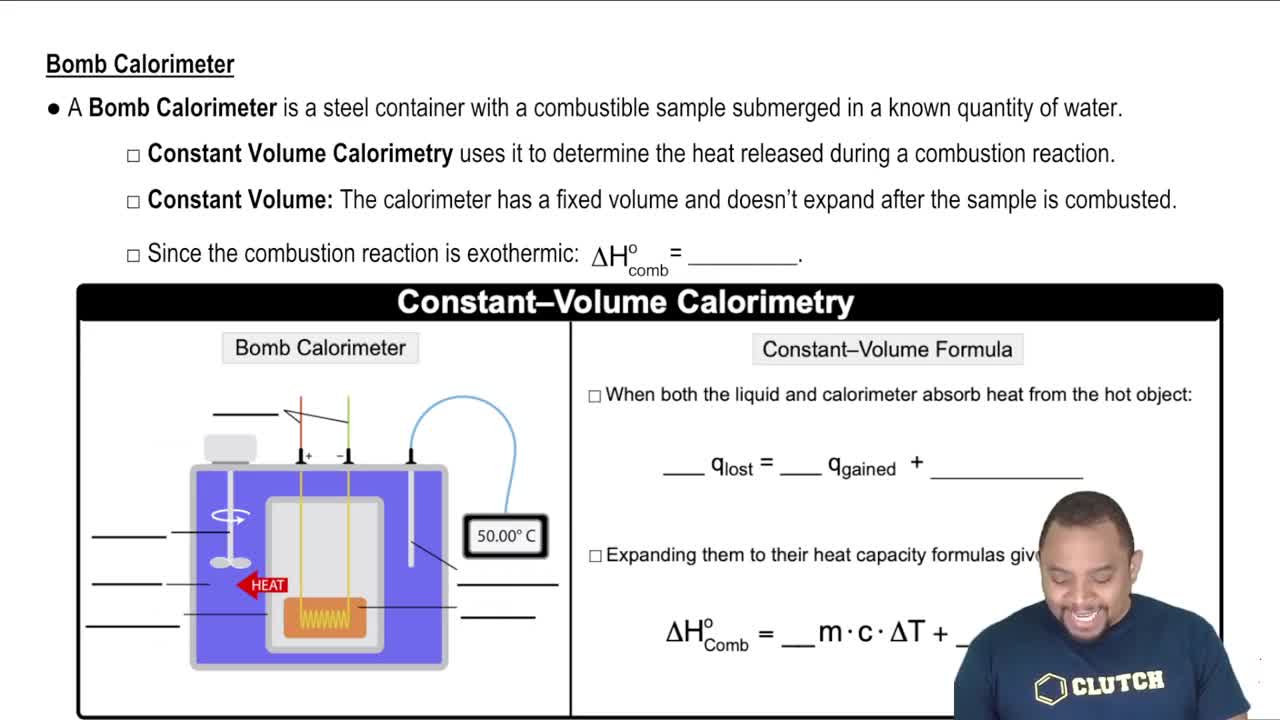
Constant-Volume Calorimetry

Unit Conversion

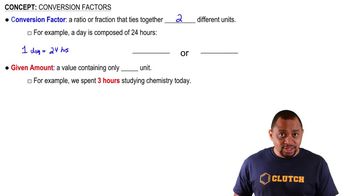
Unit conversion is the process of converting a quantity expressed in one set of units to another. In this problem, it is necessary to convert the volume from liters to cubic centimeters (cm³) since 1 L is equivalent to 1000 cm³. Mastery of unit conversion is essential in chemistry to ensure that calculations are accurate and consistent across different measurement systems.
Video consigliato:
Percorso guidato
01:56
Conversion Factors