Ch.1 - Matter, Measurement & Problem Solving
Tro - Chemistry: A Molecular Approach 6th Edition
Tro6th EditionChemistry: A Molecular ApproachISBN: 9780137832217Non è quello che usi tu?Cambia libro di testo
Capitolo 1, Problema 128

An iceberg has a volume of 7655 ft2. What is the mass of the ice (in kg) composing the iceberg (at 0 °C)?

Guida verificata passo dopo passo
1
Identify the density of ice at 0 °C, which is approximately 0.917 g/cm³.
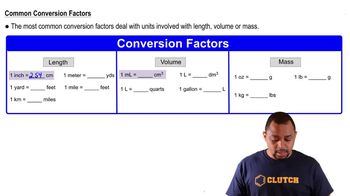
Convert the volume of the iceberg from cubic feet to cubic centimeters. Use the conversion factor: 1 ft³ = 28316.8 cm³.
Calculate the mass of the ice by multiplying the volume in cm³ by the density of ice in g/cm³.
Convert the mass from grams to kilograms by dividing by 1000, since 1 kg = 1000 g.
Ensure all units are consistent and check calculations for accuracy.

Risposta video verificata per un problema simile:

Questa soluzione video è stata consigliata dai nostri tutor come utile per risolvere questo problema.
Durata del video:
3m

Concetti chiave

Ecco i concetti essenziali che devi comprendere per rispondere correttamente alla domanda.

Density

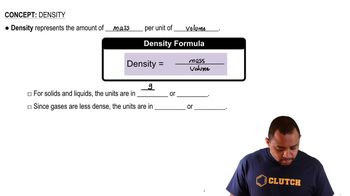
Density is defined as mass per unit volume and is a crucial property of materials. For ice, the density at 0 °C is approximately 0.917 g/cm³. This means that for every cubic centimeter of ice, it has a mass of 0.917 grams. Understanding density allows us to convert the volume of the iceberg into mass using the formula: mass = density × volume.
Video consigliato:
Percorso guidato
01:56
Density Concepts

Volume Conversion

In this problem, the volume of the iceberg is given in square feet (ft²), which is a measure of area, not volume. To find the mass of the ice, we need to ensure that the volume is expressed in cubic feet (ft³). This requires understanding the dimensions of the iceberg and converting the area into a three-dimensional volume, which is essential for accurate calculations.
Video consigliato:
Percorso guidato
02:38
Common Conversion Factors

Unit Conversion

Unit conversion is the process of converting a quantity expressed in one set of units to another. In this case, we need to convert the mass from grams to kilograms, as the final answer requires the mass in kg. Knowing that 1 kg equals 1000 grams is essential for this conversion, ensuring that the final result is in the correct units.
Video consigliato:
Percorso guidato
01:56
Conversion Factors