Ch.1 - Matter, Measurement & Problem Solving
Tro - Chemistry: A Molecular Approach 6th Edition
Tro6th EditionChemistry: A Molecular ApproachISBN: 9780137832217Non è quello che usi tu?Cambia libro di testo
Capitolo 1, Problema 87a

Calculate to the correct number of significant figures. a. 97.530 * 4.020 / 100.04

Guida verificata passo dopo passo
1
Identify the number of significant figures in each number: 97.530 has 5 significant figures, 4.020 has 4 significant figures, and 100.04 has 5 significant figures.
Perform the multiplication first: Multiply 97.530 by 4.020.
Determine the number of significant figures for the result of the multiplication: The result should have the same number of significant figures as the number with the fewest significant figures in the multiplication, which is 4 (from 4.020).
Perform the division: Divide the result of the multiplication by 100.04.
Determine the number of significant figures for the final result: The final result should have the same number of significant figures as the number with the fewest significant figures in the entire calculation, which is 4 (from the multiplication step).

Risposta video verificata per un problema simile:

Questa soluzione video è stata consigliata dai nostri tutor come utile per risolvere questo problema.
Durata del video:
3m

Concetti chiave

Ecco i concetti essenziali che devi comprendere per rispondere correttamente alla domanda.

Significant Figures

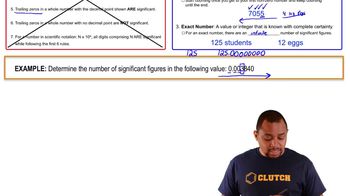
Significant figures are the digits in a number that contribute to its precision. This includes all non-zero digits, any zeros between significant digits, and trailing zeros in the decimal portion. Understanding significant figures is crucial for accurately reporting measurements and calculations in chemistry, as it reflects the precision of the data used.
Video consigliato:
Percorso guidato
01:09
Significant Figures Example

Multiplication and Division Rules for Significant Figures

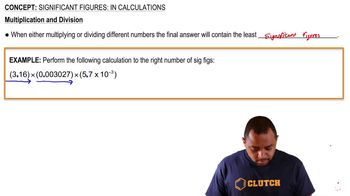
When performing multiplication or division, the result should be reported with the same number of significant figures as the measurement with the least number of significant figures. This rule ensures that the precision of the result is not overstated and reflects the least precise measurement involved in the calculation.
Video consigliato:
Percorso guidato
03:11
Significant Figures in Multiplication and Division

Order of Operations

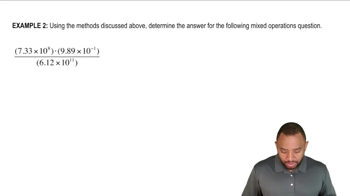
The order of operations is a set of rules that dictates the sequence in which calculations should be performed to ensure accurate results. In chemistry calculations, it is essential to follow these rules—parentheses first, then exponents, followed by multiplication and division (from left to right), and finally addition and subtraction—to avoid errors in the final answer.
Video consigliato:
Percorso guidato
03:10
Scientific Notation Mixed Operations