Ch.1 - Matter, Measurement & Problem Solving
Tro - Chemistry: A Molecular Approach 6th Edition
Tro6th EditionChemistry: A Molecular ApproachISBN: 9780137832217Non è quello che usi tu?Cambia libro di testo
Capitolo 1, Problema 61b

Complete the table. b. 515 km _____dm _____cm

Guida verificata passo dopo passo
1
Understand the metric conversion factors: 1 kilometer (km) is equal to 10,000 decimeters (dm) and 100,000 centimeters (cm).
Start with the given value in kilometers: 515 km.
Convert kilometers to decimeters by multiplying the number of kilometers by 10,000 (since 1 km = 10,000 dm).
Convert kilometers to centimeters by multiplying the number of kilometers by 100,000 (since 1 km = 100,000 cm).
Fill in the table with the calculated values for decimeters and centimeters.

Risposta video verificata per un problema simile:

Questa soluzione video è stata consigliata dai nostri tutor come utile per risolvere questo problema.
Durata del video:
1m

Concetti chiave

Ecco i concetti essenziali che devi comprendere per rispondere correttamente alla domanda.

Unit Conversion

Unit conversion is the process of converting a quantity expressed in one unit to another unit. In this case, it involves converting kilometers (km) to decimeters (dm) and centimeters (cm). Understanding the relationships between different metric units is essential for accurate conversions.
Video consigliato:
Percorso guidato
01:56
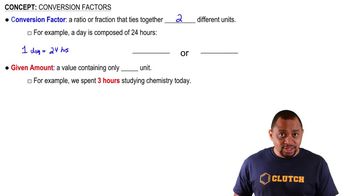
Conversion Factors

Metric System

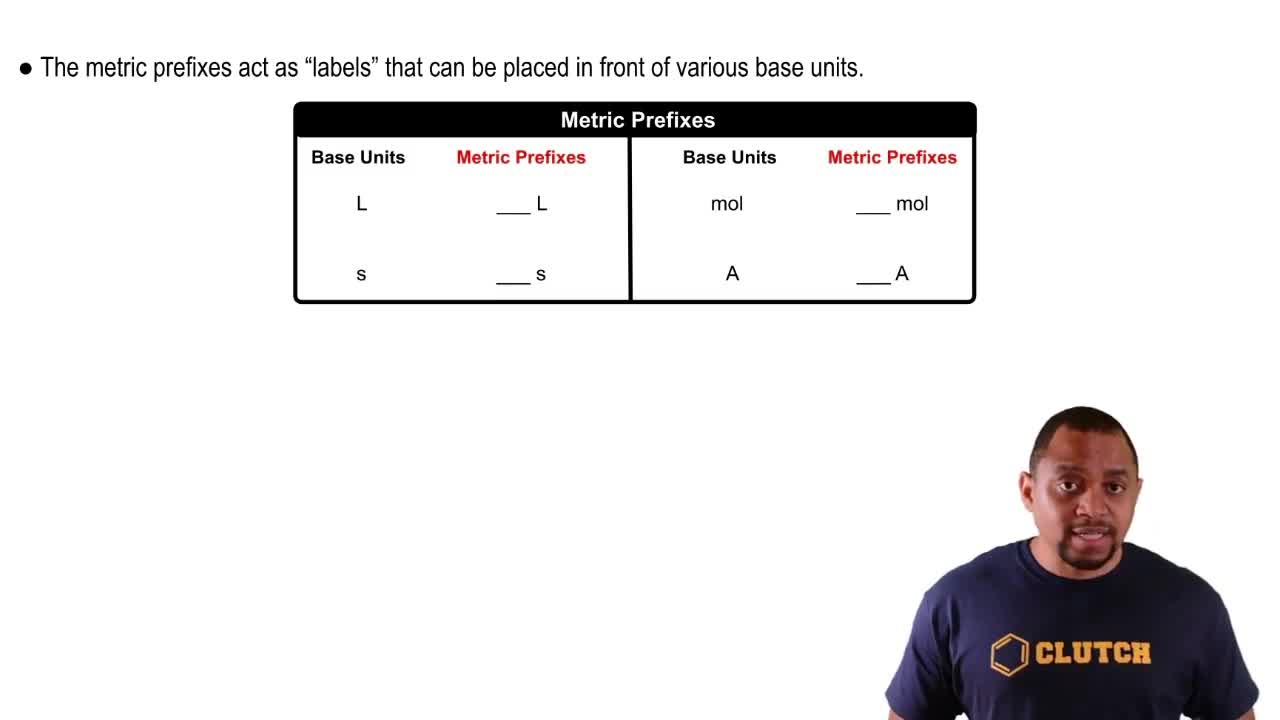
The metric system is a decimal-based system of measurement used worldwide, which includes units such as meters, liters, and grams. Each unit can be divided or multiplied by powers of ten, making conversions straightforward. Familiarity with the metric prefixes (kilo-, deci-, centi-) is crucial for effective unit conversion.
Video consigliato:
Percorso guidato
01:16
Metric Prefixes Usage

Dimensional Analysis

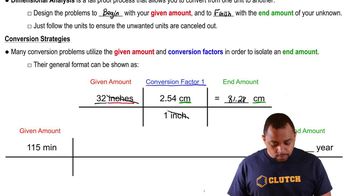
Dimensional analysis is a mathematical technique used to convert one unit of measurement to another by using conversion factors. It involves multiplying the original measurement by a fraction that represents the relationship between the units. This method ensures that units cancel appropriately, leading to the correct final unit.
Video consigliato:
Percorso guidato
06:11
Dimensional Analysis