
Ch.1 - Matter, Measurement & Problem Solving
Tro - Chemistry: A Molecular Approach 6th Edition
Tro6th EditionChemistry: A Molecular ApproachISBN: 9780137832217Non è quello che usi tu?Cambia libro di testo
Capitolo 1, Problema 42

Determine whether each molecular diagram represents a pure substance or a mixture. If it represents a pure substance, classify the substance as an element or a compound. If it represents a mixture, classify the mixture as homogeneous or heterogeneous.
Three molecular diagrams illustrating pure substances and mixtures for classification.

Guida verificata passo dopo passo
1
Observe the molecular diagrams carefully to identify the types of particles present in each diagram.
For Diagram I, note that all particles are identical green spheres, indicating a pure substance. Since there is only one type of atom, classify it as an element.
For Diagram II, observe that there are two types of particles: red and yellow spheres bonded together in pairs. This indicates a pure substance composed of two different elements, classifying it as a compound.
For Diagram III, notice the presence of different types of particles: blue, black, purple, and grey spheres, some bonded and some not. This indicates a mixture. Since the particles are uniformly distributed, classify it as a homogeneous mixture.
Summarize the classifications: Diagram I is a pure substance (element), Diagram II is a pure substance (compound), and Diagram III is a homogeneous mixture.

Risposta video verificata per un problema simile:

Questa soluzione video è stata consigliata dai nostri tutor come utile per risolvere questo problema.
Durata del video:
1m

Concetti chiave

Ecco i concetti essenziali che devi comprendere per rispondere correttamente alla domanda.

Pure Substances

A pure substance consists of only one type of particle, which can be either an element or a compound. Elements are made up of a single type of atom, while compounds consist of two or more different types of atoms chemically bonded together. In the molecular diagrams, pure substances will show uniformity in particle type and arrangement.
Video consigliato:
Percorso guidato
02:58
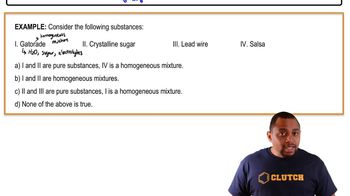
Classification of Matter Example

Mixtures

A mixture contains two or more different types of particles that are not chemically bonded. Mixtures can be classified as homogeneous, where the components are evenly distributed and indistinguishable, or heterogeneous, where the different components are easily identifiable. The arrangement of particles in the diagrams will help determine if a mixture is homogeneous or heterogeneous.
Video consigliato:
Percorso guidato
01:03
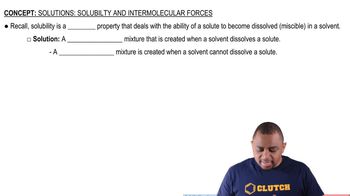
Solubility and Mixtures

Molecular Representation

Molecular diagrams visually represent the arrangement and types of particles in a substance. The colors and shapes of the particles in the diagrams indicate different elements or compounds. Analyzing these representations allows for the classification of substances as pure or mixtures, and further categorization into elements, compounds, homogeneous, or heterogeneous mixtures.
Video consigliato:
Percorso guidato
02:38
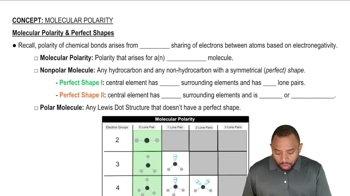
Molecular Polarity