
Ch.1 - Matter, Measurement & Problem Solving
Tro - Chemistry: A Molecular Approach 6th Edition
Tro6th EditionChemistry: A Molecular ApproachISBN: 9780137832217Non è quello che usi tu?Cambia libro di testo
Capitolo 1, Problema 8

Indicate the number of significant figures in each number. If the number is an exact number, indicate an unlimited number of significant figures. a. 318,857,056 (2014 U.S. population) b. 2.54 cm = 1 in. c. 11.4 g/cm³ (density of lead) d. 12 = 1 dozen.

Guida verificata passo dopo passo
1
Step 1: Identify the number of significant figures in the number 318,857,056. Since this is a measured value (2014 U.S. population), count all the digits as significant. There are no leading or trailing zeros to consider.
Step 2: Examine the conversion factor 2.54 cm = 1 in. This is a defined relationship between centimeters and inches, making it an exact number. Therefore, it has an unlimited number of significant figures.
Step 3: Look at the number 11.4 g/cm³, which represents the density of lead. This is a measured value, so count all the digits. The number has three significant figures.
Step 4: Consider the number 12 = 1 dozen. This is a defined quantity, meaning it is an exact number. Therefore, it has an unlimited number of significant figures.
Step 5: Summarize the findings: a. 318,857,056 has 9 significant figures, b. 2.54 cm = 1 in. has unlimited significant figures, c. 11.4 g/cm³ has 3 significant figures, d. 12 = 1 dozen has unlimited significant figures.

Concetti chiave

Ecco i concetti essenziali che devi comprendere per rispondere correttamente alla domanda.

Significant Figures

Significant figures are the digits in a number that contribute to its precision. This includes all non-zero digits, any zeros between significant digits, and trailing zeros in the decimal portion. Understanding significant figures is crucial for accurately reporting measurements and calculations in scientific contexts.
Video consigliato:
Percorso guidato
01:09
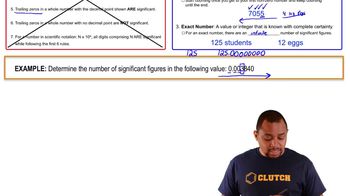
Significant Figures Example

Exact Numbers

Exact numbers are values that are counted or defined rather than measured, and they have an infinite number of significant figures. Examples include counts of objects (like 12 eggs in a dozen) or defined quantities (like 1 inch = 2.54 cm). Recognizing exact numbers is important for determining how many significant figures to report in calculations.
Video consigliato:
Percorso guidato
00:46
Number of Electrons in Shells

Measurement and Precision

Measurement refers to the process of quantifying physical quantities, while precision indicates the degree of reproducibility of measurements. In chemistry, understanding the precision of measurements helps in determining the appropriate number of significant figures to use, ensuring that results reflect the reliability of the data collected.
Video consigliato:
Percorso guidato
01:49
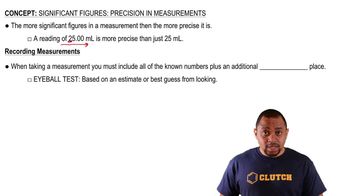
Significant Figures Precision