Ch.1 - Matter, Measurement & Problem Solving
Tro - Chemistry: A Molecular Approach 6th Edition
Tro6th EditionChemistry: A Molecular ApproachISBN: 9780137832217Non è quello che usi tu?Cambia libro di testo
Capitolo 1, Problema 144

Mercury is often used in thermometers. The mercury sits in a bulb on the bottom of the thermometer and rises up a thin capillary as the temperature rises. Suppose a mercury thermometer contains 3.380 g of mercury and has a capillary that is 0.200 mm in diameter. How far does the mercury rise in the capillary when the temperature changes from 0.0 °C to 25.0 °C? The density of mercury at these temperatures is 13.596 g/cm3 and 13.534 g/cm3, respectively

Guida verificata passo dopo passo
1
Calculate the volume of mercury at 0.0 °C using the mass and density: \( V = \frac{m}{\rho} \).
Calculate the volume of mercury at 25.0 °C using the mass and density: \( V = \frac{m}{\rho} \).
Determine the change in volume of mercury by subtracting the initial volume from the final volume.
Calculate the cross-sectional area of the capillary using the formula for the area of a circle: \( A = \pi \left(\frac{d}{2}\right)^2 \), where \( d \) is the diameter.
Find the height the mercury rises by dividing the change in volume by the cross-sectional area: \( h = \frac{\Delta V}{A} \).

Risposta video verificata per un problema simile:

Questa soluzione video è stata consigliata dai nostri tutor come utile per risolvere questo problema.
Durata del video:
7m

Concetti chiave

Ecco i concetti essenziali che devi comprendere per rispondere correttamente alla domanda.

Density

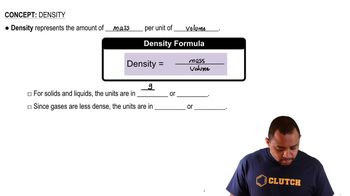
Density is defined as mass per unit volume and is a crucial property of materials. In this context, the density of mercury at different temperatures is essential for calculating how much volume the mercury occupies when heated. The formula for density is ρ = m/V, where ρ is density, m is mass, and V is volume. Understanding how density changes with temperature helps predict the behavior of substances in response to thermal expansion.
Video consigliato:
Percorso guidato
01:56
Density Concepts

Thermal Expansion

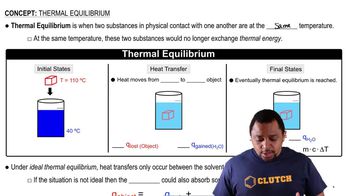
Thermal expansion refers to the increase in volume of a substance as its temperature rises. In the case of mercury in a thermometer, as the temperature increases, the kinetic energy of the mercury atoms increases, causing them to occupy more space. This principle is fundamental to the operation of thermometers, as it allows the liquid to rise in the capillary tube, providing a visual indication of temperature changes.
Video consigliato:
Percorso guidato
02:35
Thermal Equilibrium

Capillary Action

Capillary action is the ability of a liquid to flow in narrow spaces without the assistance of external forces, due to intermolecular forces. In a thermometer, the narrow capillary tube allows mercury to rise as it expands with heat. This phenomenon is influenced by the adhesive forces between the liquid and the walls of the tube, as well as the cohesive forces within the liquid itself, making it essential for understanding how the mercury moves in response to temperature changes.
Video consigliato:
Percorso guidato
2:04
Intermolecular vs Intramolecular Example