Ch.10 - Chemical Bonding I: The Lewis Model
Tro - Chemistry: A Molecular Approach 6th Edition
Tro6th EditionChemistry: A Molecular ApproachISBN: 9780137832217Non è quello che usi tu?Cambia libro di testo
Capitolo 10, Problema 107

Draw the Lewis structure for HCSNH2. The carbon and nitrogen atoms are bonded together, and the sulfur atom is bonded to the carbon atom. Label each bond in the molecule as polar or nonpolar.

Guida verificata passo dopo passo
1
Identify the total number of valence electrons in the molecule. Hydrogen (H) has 1 valence electron, carbon (C) has 4, sulfur (S) has 6, and nitrogen (N) has 5. Calculate the total by adding these together.
Arrange the atoms in the specified order: H-C-S-N-H-H. Connect the atoms with single bonds initially, ensuring that C is bonded to S and N, and N is bonded to the two H atoms.
Distribute the remaining valence electrons to satisfy the octet rule for each atom, starting with the most electronegative atoms (S and N). Remember that hydrogen only needs 2 electrons.
Check the formal charges on each atom to ensure the most stable structure. Adjust the bonding if necessary to minimize formal charges, possibly by forming double bonds.
Determine the polarity of each bond by comparing the electronegativity of the bonded atoms. A bond is polar if there is a significant difference in electronegativity between the two atoms. Label each bond as polar or nonpolar based on this analysis.

Concetti chiave

Ecco i concetti essenziali che devi comprendere per rispondere correttamente alla domanda.

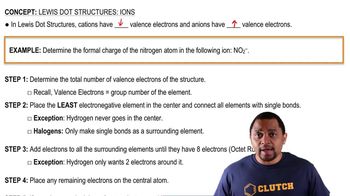
Lewis Structures

Lewis structures are diagrams that represent the bonding between atoms in a molecule and the lone pairs of electrons that may exist. They use dots to represent valence electrons and lines to represent bonds between atoms. Understanding how to draw Lewis structures is essential for visualizing molecular geometry and predicting the behavior of molecules in chemical reactions.
Video consigliato:
Percorso guidato
04:28
Lewis Dot Structures: Ions

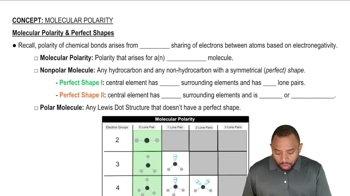
Polarity of Bonds

The polarity of a bond refers to the distribution of electrical charge between two atoms in a molecule. A bond is considered polar if there is a significant difference in electronegativity between the two atoms, leading to an unequal sharing of electrons. Nonpolar bonds occur when atoms share electrons equally, typically between identical atoms or those with similar electronegativities.
Video consigliato:
Percorso guidato
02:38
Molecular Polarity

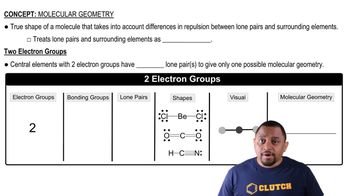
Molecular Geometry

Molecular geometry describes the three-dimensional arrangement of atoms within a molecule. It is influenced by the number of bonds and lone pairs around the central atom, which can affect the molecule's polarity and reactivity. Understanding molecular geometry is crucial for predicting how molecules interact with each other and their physical properties.
Video consigliato:
Percorso guidato
01:33
Molecular Geometry with Two Electron Groups