Ch.10 - Chemical Bonding I: The Lewis Model
Tro - Chemistry: A Molecular Approach 6th Edition
Tro6th EditionChemistry: A Molecular ApproachISBN: 9780137832217Non è quello che usi tu?Cambia libro di testo
Capitolo 10, Problema 49

Use the Born–Haber cycle and data from Appendix IIB, Chapter 9 and this chapter to calculate the lattice energy of LiBr. (ΔHsub for lithium is 138 kJ>mol.)

Guida verificata passo dopo passo
1
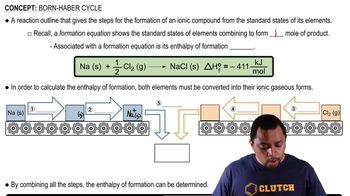
Identify the steps involved in the Born–Haber cycle for LiBr, which include sublimation of lithium, ionization of lithium, dissociation of bromine, electron affinity of bromine, and formation of LiBr from gaseous ions.
Write the equation for the sublimation of lithium: \( \text{Li(s)} \rightarrow \text{Li(g)} \) with \( \Delta H_{\text{sub}} = 138 \text{ kJ/mol} \).
Write the equation for the ionization of gaseous lithium: \( \text{Li(g)} \rightarrow \text{Li}^+(g) + e^- \) and use the ionization energy from the appendix.
Write the equation for the dissociation of bromine: \( \frac{1}{2} \text{Br}_2(g) \rightarrow \text{Br}(g) \) and use the bond dissociation energy from the appendix.
Write the equation for the formation of LiBr from gaseous ions: \( \text{Li}^+(g) + \text{Br}^-(g) \rightarrow \text{LiBr(s)} \) and solve for the lattice energy using Hess's law by summing all the enthalpy changes.

Risposta video verificata per un problema simile:

Questa soluzione video è stata consigliata dai nostri tutor come utile per risolvere questo problema.
Durata del video:
3m

Concetti chiave

Ecco i concetti essenziali che devi comprendere per rispondere correttamente alla domanda.

Born-Haber Cycle

The Born-Haber cycle is a thermodynamic cycle that relates the lattice energy of an ionic compound to its formation enthalpy and the energies involved in the formation of gaseous ions. It combines several steps, including sublimation, ionization, and electron affinity, to calculate the lattice energy indirectly. This cycle is essential for understanding how ionic compounds form and the energy changes associated with these processes.
Video consigliato:
Percorso guidato
03:49
Born Haber Cycle

Lattice Energy

Lattice energy is the energy released when gaseous ions combine to form an ionic solid, or conversely, the energy required to separate one mole of an ionic solid into its gaseous ions. It is a measure of the strength of the ionic bonds in the solid and is influenced by the charges of the ions and the distance between them. Higher lattice energy indicates stronger ionic interactions and greater stability of the ionic compound.
Video consigliato:

Enthalpy Changes

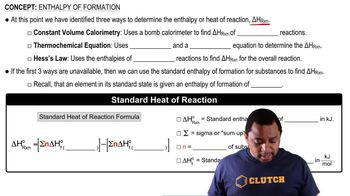
Enthalpy changes refer to the heat content changes during chemical reactions or phase changes at constant pressure. In the context of the Born-Haber cycle, various enthalpy changes such as sublimation, ionization, and electron affinity are used to calculate the overall enthalpy change for the formation of an ionic compound. Understanding these enthalpy changes is crucial for accurately determining the lattice energy and predicting the stability of ionic compounds.
Video consigliato:
Percorso guidato
02:34
Enthalpy of Formation