Draw the Lewis structure (including resonance structures) for methyl azide (CH3N3). For each resonance structure, assign formal charges to all atoms that have formal charge.
Ch.10 - Chemical Bonding I: The Lewis Model

Tro6th EditionChemistry: A Molecular ApproachISBN: 9780137832217Non è quello che usi tu?Cambia libro di testo
Capitolo 10, Problema 71
How important is the resonance structure shown here to the overall structure of carbon dioxide? Explain.

Guida verificata passo dopo passo1
Identify the resonance structure shown in the image. The structure depicts a molecule with a sulfur atom double-bonded to one oxygen atom and single-bonded to another oxygen atom, with lone pairs on the oxygen atoms.
Understand the concept of resonance. Resonance structures are different ways of drawing the same molecule, showing the delocalization of electrons within the molecule.
Analyze the resonance structure in the context of carbon dioxide (CO2). Carbon dioxide typically has two resonance structures where the carbon is double-bonded to each oxygen atom.
Compare the given structure to the typical resonance structures of CO2. The given structure is not a resonance structure of CO2 but rather a different molecule, likely sulfur dioxide (SO2).
Conclude that the resonance structure shown is not relevant to the overall structure of carbon dioxide, as it represents a different molecule.

Risposta video verificata per un problema simile:
Questa soluzione video è stata consigliata dai nostri tutor come utile per risolvere questo problema.
Durata del video:
5mConcetti chiave
Ecco i concetti essenziali che devi comprendere per rispondere correttamente alla domanda.
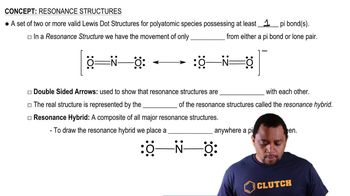
Resonance Structures
Resonance structures are different Lewis structures for the same molecule that depict the same arrangement of atoms but differ in the distribution of electrons. They are used to represent delocalized electrons within certain molecules, indicating that the actual structure is a hybrid of these forms. In carbon dioxide, resonance structures help illustrate the equivalent bonding between carbon and oxygen atoms, contributing to the molecule's stability.
Video consigliato:
Percorso guidato
Resonance Structures
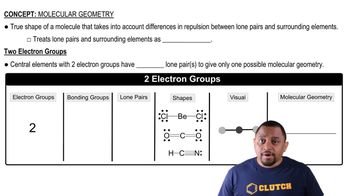
Molecular Geometry
Molecular geometry refers to the three-dimensional arrangement of atoms in a molecule. In carbon dioxide, the linear geometry arises from the arrangement of the double bonds between carbon and oxygen, which minimizes electron pair repulsion according to VSEPR theory. Understanding the geometry is crucial for predicting the molecule's reactivity and interactions with other substances.
Video consigliato:
Percorso guidato
Molecular Geometry with Two Electron Groups
Bond Order
Bond order is a measure of the number of chemical bonds between a pair of atoms, which influences the bond strength and stability. In carbon dioxide, the bond order is 2 for each C=O bond, indicating a double bond. This concept is essential for understanding the overall stability and reactivity of the molecule, as higher bond orders typically correlate with stronger, shorter bonds.
Video consigliato:
Percorso guidato
Average Bond Order
Pratica correlata
Domanda del libro di testo
2220
views
Domanda del libro di testo
In N2O, nitrogen is the central atom and the oxygen atom is terminal. In OF2, however, oxygen is the central atom. Use formal charges to explain why.
1716
views
Domanda del libro di testo
Write a Lewis structure that obeys the octet rule for each molecule or ion. Include resonance structures if necessary and assign formal charges to each atom. a. SeO2
935
views
Domanda del libro di testo
Use formal charges to identify the better Lewis structure.
1166
views
1
rank
Domanda del libro di testo
Draw the Lewis structure (including resonance structures) for the acetate ion (CH3COO-). For each resonance structure, assign formal charges to all atoms that have formal charge.
1572
views
Domanda del libro di testo
Write a Lewis structure that obeys the octet rule for each ion. Include resonance structures if necessary and assign formal charges to each atom. a. ClO3- b. ClO4- c. NO3- d. NH4+
1632
views