Ethanol is a possible fuel. Use average bond energies to calculate ΔHrxn for the combustion of ethanol. CH3CH2OH(g) + 3 O2(g) → 2 CO2(g) + 3 H2O(g)
Ch.10 - Chemical Bonding I: The Lewis Model

Tro6th EditionChemistry: A Molecular ApproachISBN: 9780137832217Non è quello che usi tu?Cambia libro di testo
Capitolo 10, Problema 90
In the Chemistry and the Environment box on free radicals in this chapter, we discussed the importance of the hydroxyl radical in reacting with and eliminating many atmospheric pollutants. However, the hydroxyl radical does not clean up everything. For example, chlorofluorocarbons—which destroy stratospheric ozone—are not attacked by the hydroxyl radical. Consider the hypothetical reaction by which the hydroxyl radical might react with a chlorofluorocarbon: OH(g) + CF2Cl2(g) → HOF(g) + CFCl2(g) Use bond energies to explain why this reaction is improbable. (The C–F bond energy is 552 kJ/mol.)
Guida verificata passo dopo passo1
Identify the bonds broken and formed in the reaction: OH(g) + CF_2Cl_2(g) -> HOF(g) + CFCl_2(g).
Calculate the total energy required to break the bonds in the reactants. This includes the O-H bond in OH and one C-F bond in CF_2Cl_2.
Calculate the total energy released when new bonds are formed in the products. This includes the H-O bond in HOF and the C-Cl bond in CFCl_2.
Use the bond energies to calculate the net energy change for the reaction: Net energy change = (Energy required to break bonds) - (Energy released in forming bonds).
Discuss the significance of the net energy change: If the net energy change is positive, the reaction is endothermic and less likely to occur spontaneously, explaining why the reaction is improbable.

Risposta video verificata per un problema simile:
Questa soluzione video è stata consigliata dai nostri tutor come utile per risolvere questo problema.
Durata del video:
7mConcetti chiave
Ecco i concetti essenziali che devi comprendere per rispondere correttamente alla domanda.
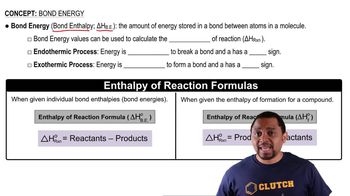
Bond Energy
Bond energy is the amount of energy required to break a bond between two atoms in a molecule. It is a crucial factor in determining the feasibility of a chemical reaction. In the context of the reaction between the hydroxyl radical and chlorofluorocarbon, the high bond energy of the C-F bond (552 kJ/mol) suggests that breaking this bond requires significant energy, making the reaction less likely to occur spontaneously.
Video consigliato:
Percorso guidato
Bond Energy
Reaction Mechanism
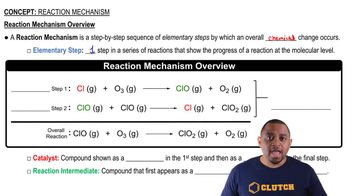
A reaction mechanism describes the step-by-step sequence of elementary reactions by which overall chemical change occurs. Understanding the mechanism helps predict whether a reaction will proceed based on the stability of intermediates and the energy required to break existing bonds. In this case, the mechanism would involve the formation of new bonds and the breaking of strong C-F bonds, which complicates the likelihood of the reaction occurring.
Video consigliato:
Percorso guidato
Reaction Mechanism Overview
Thermodynamics of Reactions
Thermodynamics in chemistry refers to the study of energy changes during chemical reactions. The Gibbs free energy change (ΔG) determines whether a reaction is spontaneous. If the energy required to break the C-F bond exceeds the energy released from forming new bonds, the reaction will not be favorable. Thus, analyzing the thermodynamic aspects of the proposed reaction is essential to understand its improbability.
Video consigliato:
Percorso guidato
First Law of Thermodynamics
Pratica correlata
Domanda del libro di testo
2906
views
Domanda del libro di testo
Write an appropriate Lewis structure for each compound. Make certain to distinguish between ionic and molecular compounds. b. ClF5
586
views
Domanda del libro di testo
Ethane burns in air to form carbon dixode and water vapor.
2 H3C¬CH3( g) + 7 O2( g)¡4 CO2( g) + 6 H2O( g)
Use average bond energies to calculate ΔHrxn for the reaction.
2
views
Domanda del libro di testo
Hydrogenation reactions are used to add hydrogen across double bonds in hydrocarbons and other organic compounds. Use average bond energies to calculate ΔHrxn for the hydrogenation reaction. H2C=CH2(g) + H2(g) → H3C–CH3(g)
2669
views
1
rank
Domanda del libro di testo
Each compound contains both ionic and covalent bonds. Write ionic Lewis structures for each, including the covalent structure for the ion in brackets. Write resonance structures if necessary. a. BaCO3
517
views