Ch.10 - Chemical Bonding I: The Lewis Model
Tro - Chemistry: A Molecular Approach 6th Edition
Tro6th EditionChemistry: A Molecular ApproachISBN: 9780137832217Non è quello che usi tu?Cambia libro di testo
Capitolo 10, Problema 62b

Refer to Figure 10.10 to estimate the percent ionic character of the ClF bond.
Scatter plot showing percent ionic character vs. electronegativity difference for various compounds.

Guida verificata passo dopo passo
1
Identify the electronegativity difference between Cl and F. The electronegativity of Cl is approximately 3.0 and for F it is approximately 4.0.
Calculate the electronegativity difference: |4.0 - 3.0| = 1.0.
Locate the value of 1.0 on the x-axis (Electronegativity Difference) of the provided graph.
Find the corresponding point on the y-axis (Percent Ionic Character) that aligns with the electronegativity difference of 1.0.
Estimate the percent ionic character of the ClF bond by reading the y-axis value at the point where the electronegativity difference is 1.0.

Risposta video verificata per un problema simile:

Questa soluzione video è stata consigliata dai nostri tutor come utile per risolvere questo problema.
Durata del video:
1m

Concetti chiave

Ecco i concetti essenziali che devi comprendere per rispondere correttamente alla domanda.

Ionic Character

Ionic character refers to the degree to which a bond between two atoms exhibits ionic properties, as opposed to covalent properties. It is influenced by the difference in electronegativity between the two atoms involved in the bond. A higher ionic character indicates a greater transfer of electrons from one atom to another, resulting in the formation of charged ions.
Video consigliato:
Percorso guidato
00:56
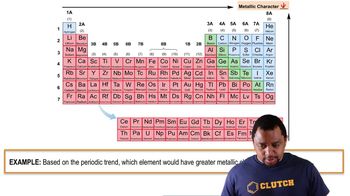
Metallic Character Example

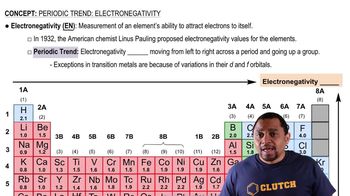
Electronegativity Difference

Electronegativity is a measure of an atom's ability to attract and hold onto electrons in a chemical bond. The electronegativity difference between two bonded atoms can help predict the bond's character; larger differences typically indicate more ionic character. For example, a difference greater than 1.7 often suggests an ionic bond, while smaller differences indicate covalent bonding.
Video consigliato:
Percorso guidato
02:10
Electronegativity Trends

Percent Ionic Character vs. Electronegativity Difference Graph

The graph plots percent ionic character against the electronegativity difference for various compounds, illustrating a trend where an increase in electronegativity difference correlates with higher percent ionic character. This visual representation helps in estimating the ionic character of specific bonds, such as the ClF bond, by locating its electronegativity difference on the x-axis and determining the corresponding ionic character on the y-axis.
Video consigliato:
Percorso guidato
00:56
Metallic Character Example