Ch.10 - Chemical Bonding I: The Lewis Model
Tro - Chemistry: A Molecular Approach 6th Edition
Tro6th EditionChemistry: A Molecular ApproachISBN: 9780137832217Non è quello che usi tu?Cambia libro di testo
Capitolo 10, Problema 81

Write the Lewis structure for each ion. Include resonance structures if necessary and assign formal charges to all atoms. If necessary, expand the octet on the central atom to lower formal charge for the following ions: a. PO4^3- b. CN^- c. SO3^2- d. ClO2^-.

Guida verificata passo dopo passo
1
Step 1: Determine the total number of valence electrons for each ion. For polyatomic ions, add electrons for negative charges and subtract for positive charges.
Step 2: Write the skeletal structure of the ion, placing the least electronegative atom in the center (except for hydrogen).
Step 3: Distribute the valence electrons around the atoms, starting with the outer atoms, to satisfy the octet rule (or duet for hydrogen).
Step 4: If there are remaining electrons, place them on the central atom. If the central atom does not have a complete octet, consider forming double or triple bonds.
Step 5: Calculate the formal charge for each atom using the formula: Formal Charge = (Valence electrons) - (Non-bonding electrons) - 0.5*(Bonding electrons). Adjust the structure to minimize formal charges, expanding the octet if necessary.

Concetti chiave

Ecco i concetti essenziali che devi comprendere per rispondere correttamente alla domanda.

Lewis Structures

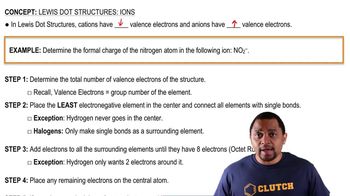
Lewis structures are diagrams that represent the bonding between atoms in a molecule and the lone pairs of electrons that may exist. They use dots to represent valence electrons and lines to represent bonds. Understanding how to draw Lewis structures is essential for visualizing molecular geometry and predicting reactivity.
Video consigliato:
Percorso guidato
04:28
Lewis Dot Structures: Ions

Formal Charge

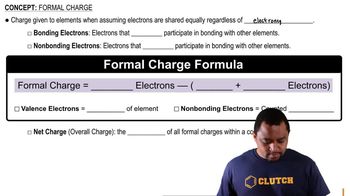
Formal charge is a theoretical charge assigned to an atom in a molecule, calculated based on the number of valence electrons, the number of non-bonding electrons, and the number of bonds. It helps in determining the most stable structure by minimizing the formal charges across the molecule. Assigning formal charges is crucial for evaluating resonance structures and the overall stability of ions.
Video consigliato:

Resonance Structures

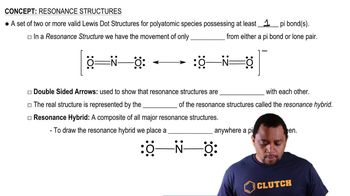
Resonance structures are different Lewis structures that represent the same molecule or ion, differing only in the arrangement of electrons. They are used to depict delocalized electrons that cannot be represented by a single structure. Understanding resonance is important for accurately representing the electron distribution and stability of molecules, especially for those with multiple valid Lewis structures.
Video consigliato:
Percorso guidato
01:42
Resonance Structures