Ch.10 - Chemical Bonding I: The Lewis Model
Tro - Chemistry: A Molecular Approach 6th Edition
Tro6th EditionChemistry: A Molecular ApproachISBN: 9780137832217Non è quello che usi tu?Cambia libro di testo
Capitolo 10, Problema 37b

Write the Lewis symbol for each atom or ion. b. K+

Guida verificata passo dopo passo
1
Identify the number of valence electrons in a neutral potassium (K) atom. Potassium is in Group 1 of the periodic table, which means it has 1 valence electron.
Determine the effect of the ion charge on the valence electrons. Since the potassium ion is K+, it has lost one electron.
Calculate the total number of valence electrons in the K+ ion. After losing one electron, the K+ ion has 0 valence electrons.
Draw the Lewis symbol for K+. The Lewis symbol consists of the chemical symbol surrounded by dots representing each valence electron. Since K+ has no valence electrons, there will be no dots around the symbol K.
Enclose the Lewis symbol in square brackets and add the charge as a superscript to indicate that it is an ion. The final Lewis symbol for K+ is [K]+.

Risposta video verificata per un problema simile:

Questa soluzione video è stata consigliata dai nostri tutor come utile per risolvere questo problema.
Durata del video:
50s

Concetti chiave

Ecco i concetti essenziali che devi comprendere per rispondere correttamente alla domanda.

Lewis Symbols

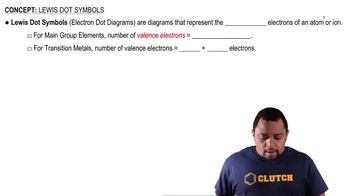
Lewis symbols, also known as Lewis dot structures, represent the valence electrons of an atom or ion. Each dot corresponds to a valence electron, and the arrangement of these dots around the chemical symbol indicates how the atom can bond with others. This visual representation helps in understanding the reactivity and bonding behavior of elements.
Video consigliato:
Percorso guidato
00:52
Lewis Dot Symbols

Valence Electrons

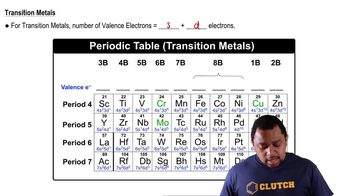
Valence electrons are the outermost electrons of an atom and are crucial in determining how an atom interacts with others. The number of valence electrons influences an atom's ability to form bonds, either by gaining, losing, or sharing electrons. For potassium (K), which is in group 1 of the periodic table, there is one valence electron that is lost when it forms a K+ ion.
Video consigliato:
Percorso guidato
02:12
Transition Metals Valence Electrons

Ionic Charge

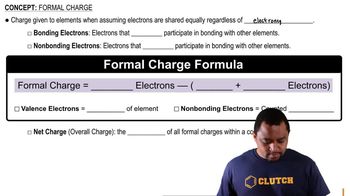
Ionic charge refers to the electrical charge that an atom or ion carries due to the loss or gain of electrons. When an atom loses electrons, it becomes positively charged (cation), while gaining electrons results in a negative charge (anion). In the case of K+, potassium has lost its single valence electron, resulting in a +1 charge, which is represented in its Lewis symbol.
Video consigliato: