Ch.11 - Chemical Bonding II: Molecular Shapes, VSEPR & MO Theory
Tro - Chemistry: A Molecular Approach 6th Edition
Tro6th EditionChemistry: A Molecular ApproachISBN: 9780137832217Non è quello che usi tu?Cambia libro di testo
Capitolo 11, Problema 92d

The genetic code is based on four different bases with the structures shown here. Assign a geometry and hybridization to each interior atom in these four bases. d. guanine
Chemical structure of guanine with labeled atoms for hybridization analysis.

Guida verificata passo dopo passo
1
Identify the hybridization of each interior atom by counting the number of sigma bonds and lone pairs around the atom.
For atom 1 (carbonyl carbon), it has 3 sigma bonds and no lone pairs, so it is sp2 hybridized with a trigonal planar geometry.
For atom 2 (nitrogen), it has 2 sigma bonds and 1 lone pair, so it is sp2 hybridized with a bent geometry.
For atom 3 (carbonyl carbon), it has 3 sigma bonds and no lone pairs, so it is sp2 hybridized with a trigonal planar geometry.
For atom 4 (carbon), it has 3 sigma bonds and no lone pairs, so it is sp2 hybridized with a trigonal planar geometry.

Risposta video verificata per un problema simile:

Questa soluzione video è stata consigliata dai nostri tutor come utile per risolvere questo problema.
Durata del video:
2m

Concetti chiave

Ecco i concetti essenziali che devi comprendere per rispondere correttamente alla domanda.

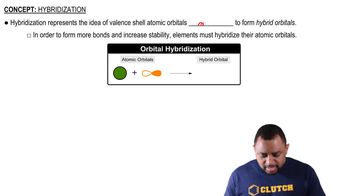
Hybridization

Hybridization is the concept of mixing atomic orbitals to form new hybrid orbitals that can accommodate the bonding requirements of atoms in a molecule. In guanine, for example, carbon atoms typically exhibit sp2 hybridization, allowing for the formation of planar structures with double bonds, while nitrogen atoms may show sp3 hybridization, accommodating lone pairs and bonding.
Video consigliato:

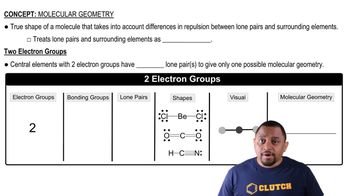
Molecular Geometry

Molecular geometry refers to the three-dimensional arrangement of atoms within a molecule. The geometry is determined by the hybridization of the central atom and the number of bonds and lone pairs surrounding it. For guanine, the arrangement of atoms leads to a specific geometry that influences its interactions and functions in biological systems.
Video consigliato:
Percorso guidato
01:33
Molecular Geometry with Two Electron Groups

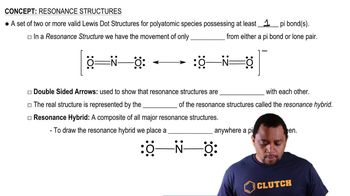
Resonance Structures

Resonance structures are different ways of drawing a molecule that represent the same arrangement of atoms but differ in the distribution of electrons. In guanine, resonance is important for understanding the delocalization of electrons in the aromatic ring and the stability of the molecule, which is crucial for its role in the genetic code.
Video consigliato:
Percorso guidato
01:42
Resonance Structures