Benzene has a heat of vaporization of 30.72 kJ/mol and a normal boiling point of 80.1 °C. At what temperature does benzene boil when the external pressure is 445 torr?
Ch.12 - Liquids, Solids & Intermolecular Forces

Tro6th EditionChemistry: A Molecular ApproachISBN: 9780137832217Non è quello che usi tu?Cambia libro di testo
Capitolo 12, Problema 73
How much energy is released when 75.2 g of water freezes?
Guida verificata passo dopo passo1
Identify the process: Freezing of water is a phase change from liquid to solid, which releases energy in the form of heat.
Determine the heat of fusion for water: The heat of fusion for water is approximately 334 J/g. This is the amount of energy released when 1 gram of water freezes.
Calculate the total energy released: Multiply the mass of the water (75.2 g) by the heat of fusion (334 J/g) to find the total energy released.
Set up the equation: Energy released = mass of water × heat of fusion.
Substitute the values into the equation and solve for the energy released.

Risposta video verificata per un problema simile:
Questa soluzione video è stata consigliata dai nostri tutor come utile per risolvere questo problema.
Durata del video:
2mConcetti chiave
Ecco i concetti essenziali che devi comprendere per rispondere correttamente alla domanda.
Heat of Fusion
The heat of fusion is the amount of energy required to change a substance from solid to liquid at its melting point, or vice versa. For water, this value is approximately 334 joules per gram. When water freezes, it releases this amount of energy per gram, which is crucial for calculating the total energy released during the freezing process.
Video consigliato:
Percorso guidato
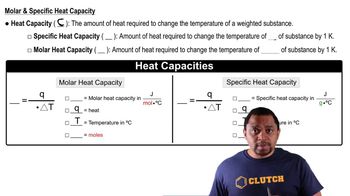
Heat Capacity
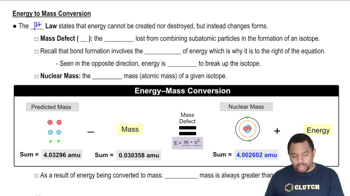
Mass and Energy Relationship
The relationship between mass and energy is fundamental in thermodynamics. In this context, the mass of the substance (water) directly influences the total energy released during a phase change. By knowing the mass of water and the heat of fusion, one can calculate the total energy released when the water freezes.
Video consigliato:
Percorso guidato
Energy to Mass Conversion
Phase Changes
Phase changes refer to the transitions between solid, liquid, and gas states of matter. Freezing is a phase change where a liquid becomes a solid, and it involves energy transfer. Understanding the nature of phase changes helps in predicting the energy dynamics involved when substances transition between different states.
Video consigliato:
Percorso guidato
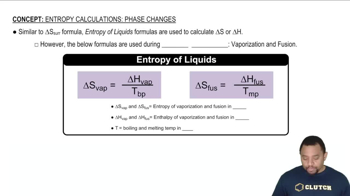
Entropy in Phase Changes
Pratica correlata
Domanda del libro di testo
1978
views
Domanda del libro di testo
A 10.5-g ice cube at 0°C is placed into 245-g of water. Calculate the temperature change in the water upon the complete melting of the ice. Assume that all of the energy required to melt the ice comes from the water.
Domanda del libro di testo
Carbon disulfide has a vapor pressure of 363 torr at 25 °C and a normal boiling point of 46.3 °C. Find ΔHvap for carbon disulfide.
2567
views
Domanda del libro di testo
Calculate the amount of heat required to completely sublime 75.0 g of solid dry ice (CO2) at its sublimation temperature. The heat of sublimation for carbon dioxide is 32.3 kJ/mol.
Domanda del libro di testo
How much ice (in grams) would have to melt to absorb 155 kJ of energy?